
Inheriting a Voice: How Transphere Localized Atomic Heart’s Second DLC into Four Asian Languages
Game Localization Case Study · ~8 minute read
Project at a glance
| Field | Detail |
| Client | Mundfish (developer). DLC published by Focus Entertainment. |
| Project | Atomic Heart — Trapped in Limbo (the second DLC of the Atomic Pass) |
| Services | Game localization: TEP (Translation, Editing, Proofreading) with terminology and style governance |
| Target languages | Simplified Chinese, Traditional Chinese, Japanese, Korean |
| Volume | ~20,000 words per language; ~80,000 words of delivered target text |
| Team | 14 linguists across four language tracks |
| Workflow | TEP with terminology governance running across all four languages |
| Engaged | 2023, as a replacement supplier for the four Asian-language versions |
| DLC release | 6 February 2024 |
| Reported error rate | Japanese 0% · Korean 0.1% · Simplified Chinese 0.1% · Traditional Chinese 0.1% |
| Since | Continued engagement with Mundfish on the Atomic Heart franchise |
In 2023, Mundfish needed a new localization supplier for the Simplified Chinese, Traditional Chinese, Japanese and Korean versions of the second Atomic Heart DLC. Transphere took it on: roughly 20,000 words per language, four language tracks, 14 linguists, delivered into Trapped in Limbo’s 6 February 2024 launch. This is an account of what that work actually involved — starting with the part that makes it unusual.
We did not localize the base game. We arrived at the second DLC, into a world that had already been built, already been named, and already been rendered into all four of our target languages by somebody else. Nothing about that vocabulary was ours to reinvent. Our job was to sound exactly like the people who came before us — in a chapter of the game that deliberately stops sounding like itself.
How Transphere joined Atomic Heart mid-franchise
Mundfish went looking for a new supplier for the four Asian-language versions of Atomic Heart’s second DLC in 2023. Two things were formally assessed: our credentials and track record in game localization, and a test translation in all four target languages. That detail is worth dwelling on, because it explains the shape of everything that followed. A supplier changeover on a live franchise is not a normal project start. There is no kickoff in which the client explains their world from scratch; there is a body of existing work, an established voice, and an expectation that the new vendor will match it without being taught. The only way through that is direct, high-bandwidth contact with the people who built it.
The world you have to learn before you can translate a line
Mundfish describes Atomic Heart as a “mad utopia”: an alternate 1955 in which people and machines coexist comfortably, right up until the moment they don’t. You play Special Agent P-3, sent to find out what went wrong at Facility 3826.
That premise is where the game’s personality comes from, and it is also where the localization difficulty comes from. Facilities, weapons, technologies, consumables, characters, in-world concepts — almost none of it maps onto something a Japanese or Korean player already has a word for. It is not quite science fiction, not quite alternate history and not quite parody, and it borrows the register of all three at once. You can render every individual word in a line like that correctly and still lose the game.
Atomic Heart travelled internationally on the strength of its design — the Twins, the elegant humanoids, a talkative refrigerator. Character design crosses borders on its own. The text underneath it does not; someone has to carry it. By the time we arrived, someone already had, in all four of our languages, and that finished text became our specification.

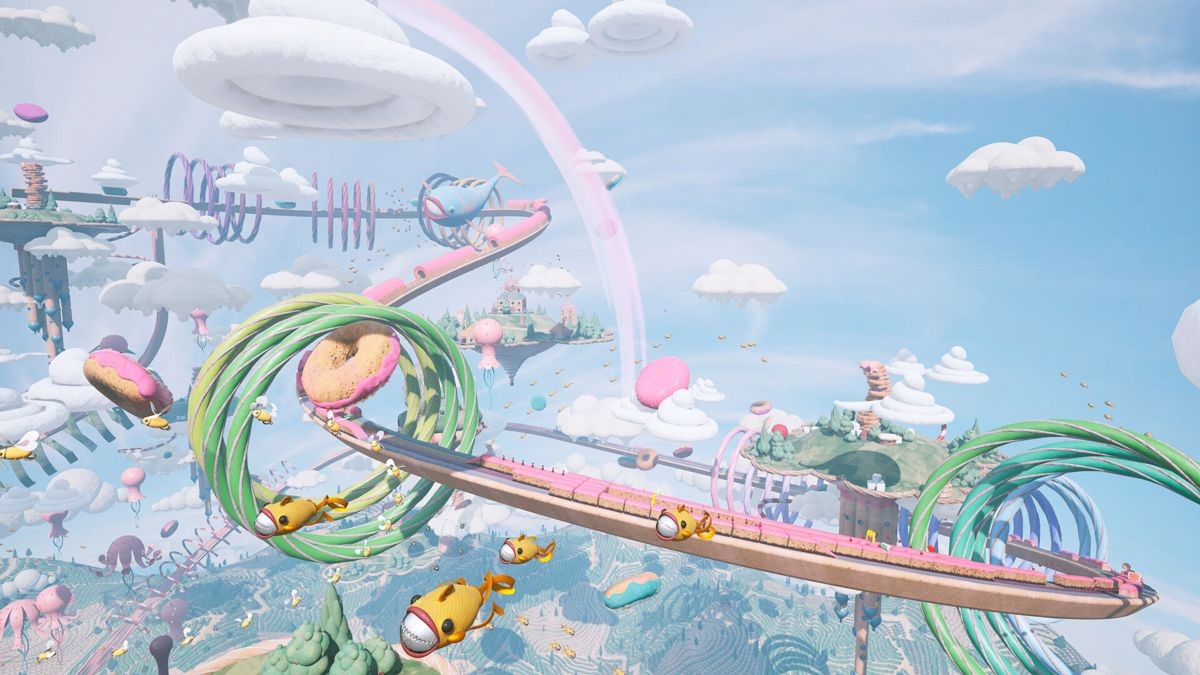
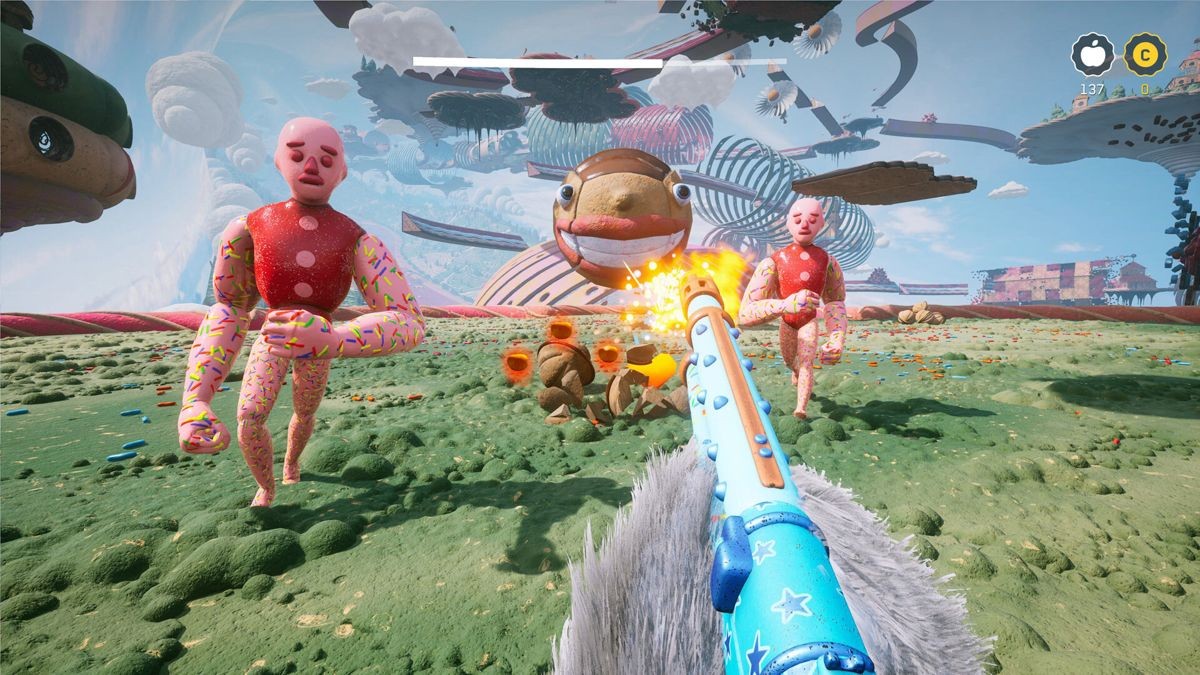
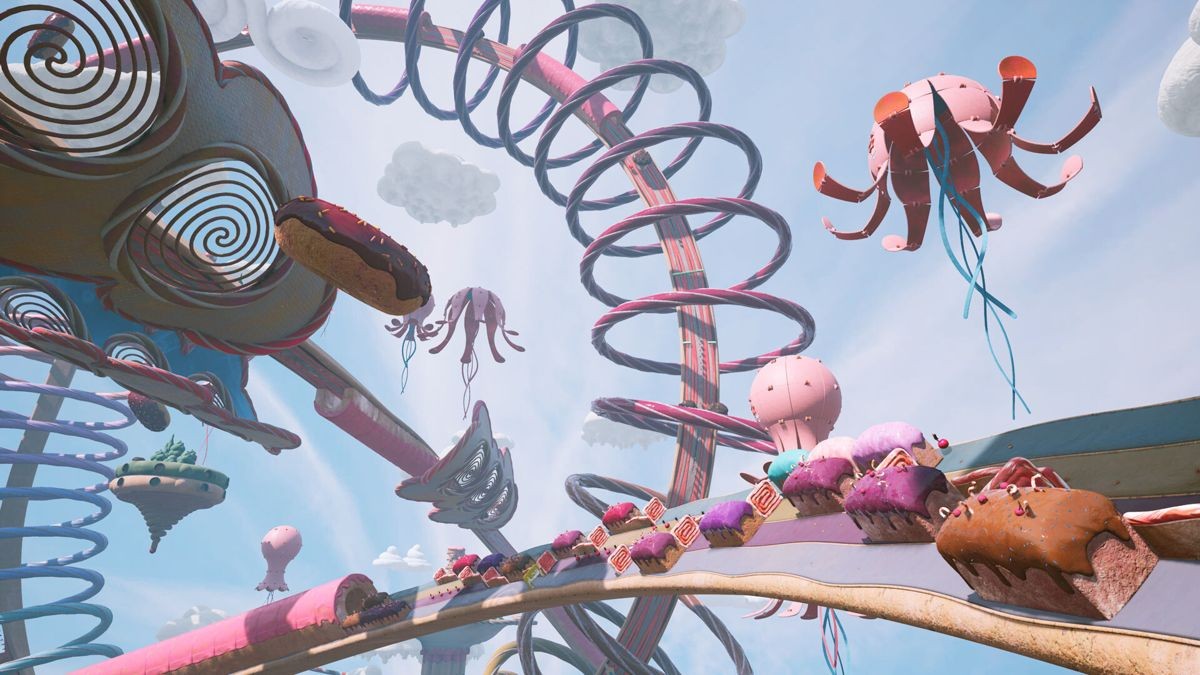

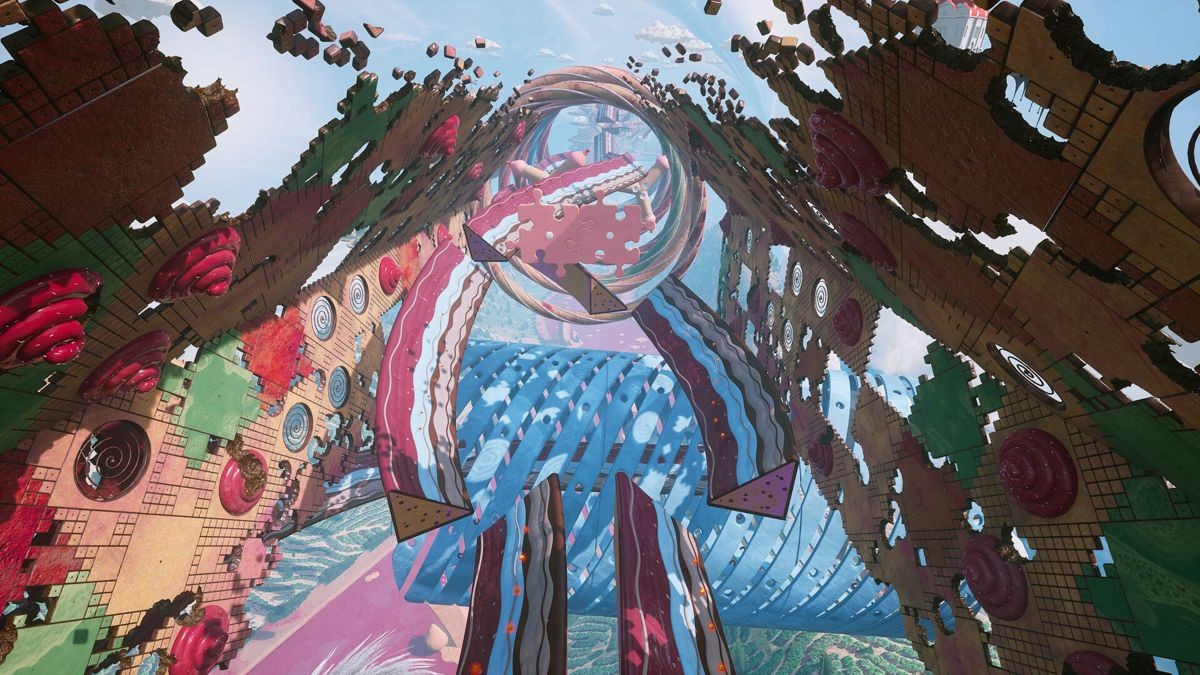
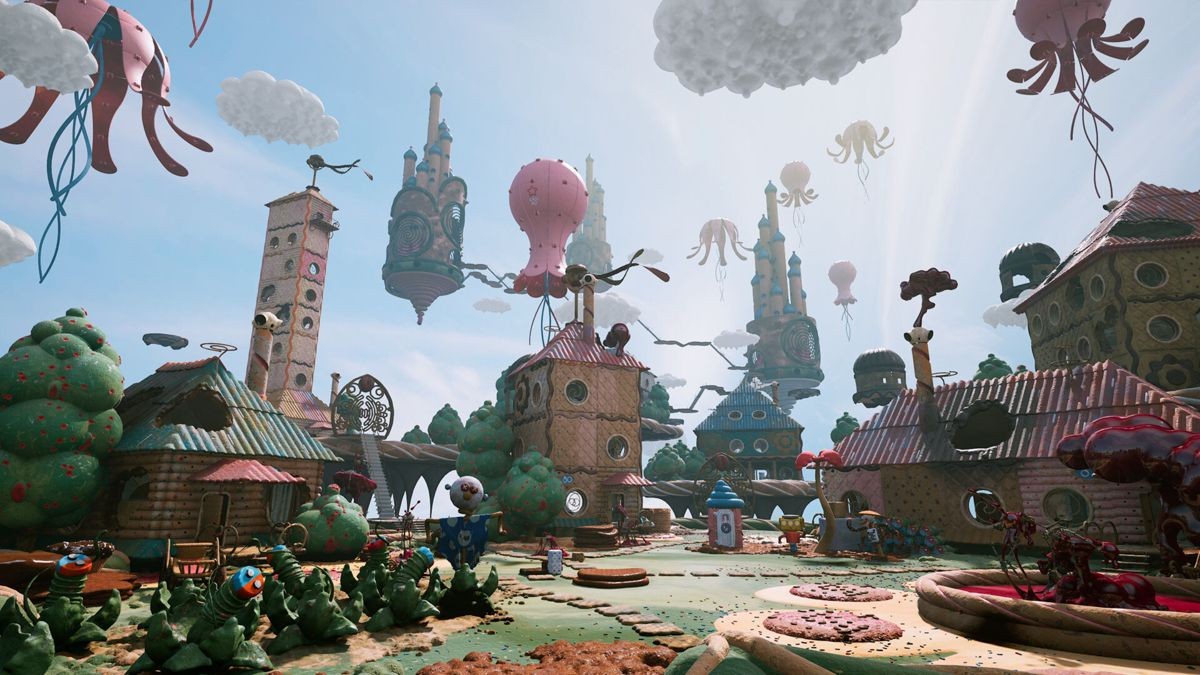
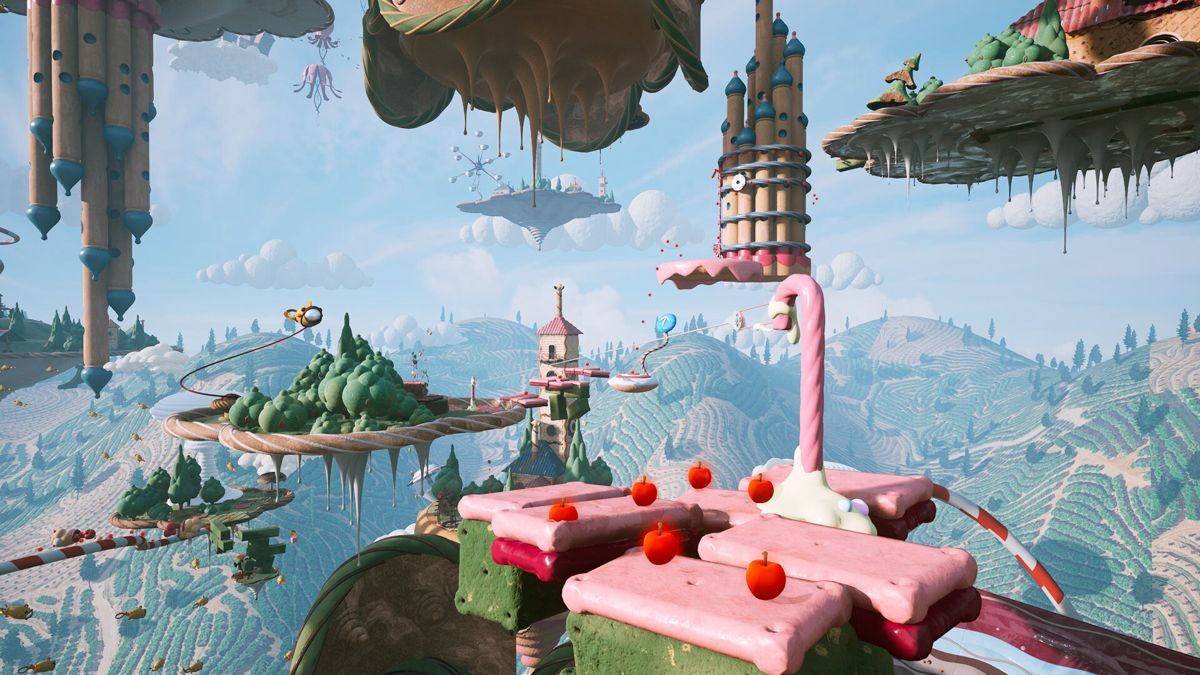

Screenshots from Atomic Heart: Trapped in Limbo
(credits: https://www.mobygames.com/game/217696/atomic-heart-trapped-in-limbo/)
The hardest problem: a DLC that breaks its own game’s tone
Trapped in Limbo released on 6 February 2024, and it is not a side story. It picks up immediately where the main game ends — though it follows a different ending from the one the first DLC, Annihilation Instinct, continued from. P-3 is pulled back into Limbo, a world running on inverted logic, and has to break through a series of obstacles to learn what becomes of him.
Facility 3826 is red and gold, institutional, heavy with Soviet-inflected officialdom. Limbo is pastel. It is a candy world: weightless, sugary, deliberately absurd.
That contrast is the entire localization problem, and it pulls in two directions at once. A DLC is expected to sound like its base game — a player who has spent twenty-five hours inside one voice will notice within a few lines if the next chapter arrives in a different one. But carry the base game’s register into Limbo unchanged and the text fights the art direction: institutional Soviet gravity narrating a candy-coloured fever dream reads as an error rather than a joke. Loosen it too far and the DLC stops sounding like Atomic Heart at all.
The line between those two failures is narrow, and it does not sit in the same place in every language. Japanese, Korean, Simplified Chinese and Traditional Chinese each draw the border between “official” and “absurd” using different machinery. The formality and honorific systems that make the base game’s bureaucratic voice land in Japanese are the same systems that make it read as merely stiff, rather than funny, once the setting turns to sugar. Chinese does much of that work through lexical register and four-character set phrases instead, which fail differently and have to be released differently. Each language team calibrated that balance on its own terms, then had the result checked against the other three so that the four versions stayed within the same tolerance rather than drifting into four different comedies.
And it branches. Because Trapped in Limbo continues one specific ending rather than the other, continuity was not simply a matter of matching the base game. It meant matching one particular reading of the base game, consistently, across Japanese, Korean, Simplified Chinese and Traditional Chinese.
How we rebuilt a style guide for a voice we hadn’t written
The standard answer to “How do you stay consistent with work you didn’t do?” is: use the glossary. During a supplier changeover, however, the glossary may be provided while the style guide is not. In this case, we have the existing terminology, but the style guide is not given by our client. What reliably exists is the shipped text itself.
To bridge this gap, Viktor Lopata, Business Development Manager at Transphere, who was our point of contact for Mundfish and the Atomic Heart team, alongside Account Manager Sandra Wang, worked directly with the client to obtain the existing bilingual material from the base game and the preceding DLC. Based on the existing glossary, style decisions that had never been documented anywhere — how characters address one another, how in-world official documents sound, where the humour sits and how dry it is allowed to be — were reverse-engineered out of the existing translations, and written up as a style guide before volume translation began.
The client had a finished game in four languages and no style guide to hand us. Rather than ask them to describe the voice from memory, we went and extracted it — pulled the legacy material, read it for how it actually behaves, wrote down the rules it was already following. By the time our linguists opened the first Limbo file, they had the base game’s rules in front of them. That is the only way you can bend one on purpose instead of by accident.
— Sandra Wang, Account Manager, Transphere
That last point is what turned an inherited constraint into working method. Every deliberate departure in Limbo — a loosened register, a joke allowed to run, a term rendered more lightly than it would have been inside Facility 3826 — could be made against a documented baseline and justified, rather than guessed at line by line.
Four languages, one game world
Transphere organized 14 linguists around a three-stage workflow — translation, editing, proofreading — with terminology governance running across all four language tracks rather than inside each of them separately.
Translators worked with context rather than isolated strings: who is speaking, where the line appears in the game, what the scene is doing, and how the term has been handled elsewhere. Editors checked linguistic quality and contextual accuracy, catching the places where a character’s voice had quietly flattened out. Given that dialogue requires voice acting, editors also paid close attention to the distinction between spoken and written language, ensuring the adaptation aligned with the characters’ backgrounds, personalities, and relationships. Proofreading was the last pass before delivery — a stage that matters disproportionately in a game, because an inconsistency is not seen just once. It is seen every time the player opens that menu.
Because all four languages worked from the same existing glossary and the same style guide, a question raised in one language was resolved once for all of them. When a legacy term no longer sat comfortably in Limbo’s register, the decision about what to do with it was made centrally and propagated — rather than being answered four different ways by four teams who never spoke.
Why the characters were the hard part
Atomic Heart’s cast is large and deliberately uneven. Its characters are separated less by what they say than by how they joke, what they refuse to say directly, and which register they drop into when things go wrong. That separation is the first thing lost in translation, because the safest rendering of any individual line is a neutral one — and neutral, applied consistently across a whole cast, quietly turns everyone into the same person.
In Limbo the risk is sharper still, because the setting is already doing so much of the comedy that it is tempting to let the dialogue go flat underneath it. The goal was the opposite: a player in Seoul or Taipei should feel that these characters were written in their language, not merely moved into it.
So did it work?
Rather than guess, the project tracked reported error rates for each delivered language version:
| Language version | Reported error rate |
| Japanese | 0% |
| Korean | 0.1% |
| Simplified Chinese | 0.1% |
| Traditional Chinese | 0.1% |
Across roughly 80,000 words of terminology-dense, voice-driven content in four languages — produced against a voice established by a previous supplier, in a setting designed to contradict it — that is the number the three-stage workflow was built to produce.
What Mundfish did next
The clearest verdict on a localization project usually isn’t a score. It is whether the client comes back with the next file.
Mundfish did. Since Trapped in Limbo shipped, they have come back to us with enquiries about the remaining Atomic Pass DLCs, and we are providing localization support for future series, which brings back familiar characters, introduces new ones, and widens the story to a global scale.

We take that seriously, and not only as a commercial outcome. Repeat work on the same IP means something specific in this industry: the client no longer has to re-explain their world, re-approve their terminology, or re-argue decisions that were settled a project ago. The style guide we reconstructed for Limbo are still in service. The linguists who learned this universe are still working inside it. Continuity of team is what makes continuity of text possible — and on a franchise that changes suppliers, it is the thing most easily lost.
That, more than the word count, is what we would point to as the result of this project. Not 80,000 words delivered, but a world we were trusted to keep writing in.
Project features
- Supplier changeover on a live franchise: four Asian-language versions taken over mid-Atomic Pass, in 2023
- Alternate-history 1955 setting with a dense, invented terminology system and heavy Soviet-inspired cultural referencing
- Glossary and style guide reconstructed from legacy bilingual material and confirmed with the client before volume translation
- Tonal continuity problem: a candy-coloured Limbo DLC that had to remain recognizably the same game as institutional Facility 3826
- Branching narrative continuity — Trapped in Limbo follows a different base-game ending from the first DLC
- ~20,000 words per language; ~80,000 words of delivered target text
- Four target languages: Japanese, Korean, Simplified Chinese, Traditional Chinese
- 14 linguists on a TEP workflow with cross-language terminology governance
- Reported error rates of 0–0.1% per language version
- Ongoing franchise engagement
Frequently asked questions
Did Transphere localize the Atomic Heart base game?
No. Transphere localized Atomic Heart’s second DLC, Trapped in Limbo, into Japanese, Korean, Simplified Chinese and Traditional Chinese. Mundfish engaged us in 2023 as a new supplier for those four Asian-language versions; the base game had already been localized by another vendor, and matching its established voice was part of our brief.
Which languages did Transphere localize Trapped in Limbo into?
Four: Japanese, Korean, Simplified Chinese and Traditional Chinese — roughly 20,000 words per language, about 80,000 words of delivered target text in total, produced by a team of 14 linguists.
How do you keep a DLC consistent with a base game localized by a different vendor?
By treating the shipped text as the specification. Transphere obtained the existing bilingual material from the base game and the preceding DLC, adopted the existing terminology and adapted accordingly, reverse-engineered the undocumented style rules the previous translations were already following, confirmed those rules with the client. Consistency on a changeover is an extraction problem before it is a translation problem.
What was the hardest part of localizing Trapped in Limbo?
Tone. Trapped in Limbo is set in Limbo — a pastel, weightless, deliberately absurd candy world — while the base game it has to stay consistent with is institutional, Soviet-inflected and heavy. Reproducing the base game’s register unchanged makes the DLC read as a mistake; loosening it too far makes it stop sounding like Atomic Heart. Each of the four languages marks the boundary between official and absurd with different grammatical and lexical machinery, so each team had to find that balance separately and then be reconciled against the others.
What quality results did the project achieve?
Reported error rates of 0% for Japanese and 0.1% for Korean, Simplified Chinese and Traditional Chinese, across roughly 80,000 words of delivered target text. The project ran a three-stage translation–editing–proofreading workflow with terminology governance shared across all four language tracks.
Does Transphere take on ongoing game franchises?
Yes, including mid-franchise handovers. Transphere’s engagement with Mundfish began at the second Atomic Heart DLC and has continued since, with enquiries on the remaining Atomic Pass content and localization support for future series.
About Transphere
Transphere is the localization branch of Sunyu Transphere, a language services provider headquartered in Nanjing, China. We work with game developers and publishers on video game localization, localization testing and multilingual content — so that a team that built a world in one language can hand it to players in another without losing what made it worth building.
Planning a launch, a new market, or a franchise that is about to grow?