

A multilingual translation company is a specialized organization that provides cross-language communication and translation services. Professional multilingual translation companies gather a team of skilled translators with proficiency in multiple languages and cultural understanding. It is dedicated to assisting clients in communicating and disseminating information in different language environments.
A professional multilingual translation agency offers high-quality language translation and localization services, ensuring accurate conveyance of the original meaning and style. They handle various translation requirements, including translation, business interpreting company, and localization across different languages. They understand clients’ specific needs and objectives and provide customized translation solutions.
The service scope of a multilingual translation agency generally includes:
- Translation: This involves translating documents, files, contracts, website content, marketing materials, and more.
- Interpretation: They provide interpretation services for conferences, seminars, exhibitions, etc., ensuring real-time language communication.
- Localization: They localize products, applications, websites, etc., adapting them to fit the culture and customs of the target market.
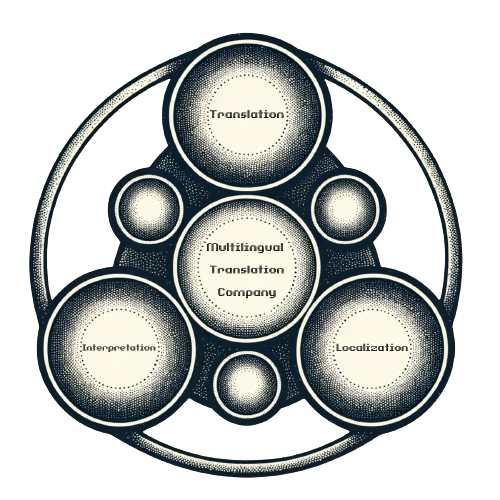
In summary, the duty of a multilingual translation company is to provide professional and high-quality translation services, helping clients communicate and disseminate information smoothly in multilingual environments while meeting the translation needs of various industries or fields.
What is the workflow of a multilingual translation company?
- Project acceptance and assignment
Clients submit translation project requirements, including source files, target languages, delivery dates, etc. The business escort interpretation company conducts project evaluation, determines the required resources and time, and negotiates relevant details with the client. The project manager assigns the project to suitable translators or teams.
- Terminology management and the use of translation memory
Multilingual translation agencies usually establish terminology databases that contain industry-specific terms and vocabulary. Translators refer to the terminology database during the translation process to ensure consistency and accuracy of terms. Translation memory records previously translated sentences and paragraphs, which can enhance translation efficiency and consistency.
- Translator selection and training
Multilingual translation agencies have an experienced and highly qualified team of translators. Translators are selected and assigned based on their language proficiency, subject matter expertise, and experience. The agencies provide training to translators to familiarize them with their workflow, terminology management system, and quality requirements.
- Translation quality control and proofreading process
Translation projects need a rigorous quality control process to ensure accuracy and consistency in translation. After completing the translation, translators should self-proofread and edit to ensure accurate language expression. Translation projects may need professional proofreading and editing by other translators or experts to review and modify the translated text. The final translation documents delivered to clients undergo a final quality review to ensure compliance with client requirements and industry standards.
Throughout the entire workflow, multilingual translation agencies emphasize quality control and communication. Project managers maintain close contact with clients, providing timely updates on project progress and addressing any issues. Additionally, translation companies continuously improve their workflow and technological tools to enhance translation efficiency and quality, aiming to meet client needs.
Is hiring a multilingual translation company worth it?
Absolutely, though the suitability hinges on the specific requirements of your project. The crucial factor in this decision is quality. When your project is pivotal or necessitates elevated levels of precision and quality, opting for translation agencies is a judicious choice.
These agencies offer a fusion of access to multilingual linguists and industry-specific experts, ensuring that every piece of translated work is treated with the utmost care and attention to detail. This, in tandem with robust data security protocols and meticulous management processes, enables these agencies to deliver translations of the highest caliber and reliability. Additionally, their comprehensive structure allows them the capacity and adaptability to undertake a wide array of projects, regardless of their scale or complexity.
Contrastingly, replicating such capabilities with freelancers or individual translators may prove challenging or might demand considerable flexibility on your part. While independent translators bring their own strengths, the comprehensive service and reliability offered by multilingual translation companies often make them a more suitable option for projects where quality cannot be compromised.
When might multilingual translation companies be unnecessary?
There are three core situations when an agency may be unnecessary:
- Small-Scale or Informal Projects: If you have a tiny project or informal content where precision and cultural nuances are not critical, professional translation services might be an overinvestment.
- Budget Constraints: The cost of a full-service translation agency might be prohibitive for businesses operating on a tight budget, especially startups.
- Non-critical Content: In cases where the translated content is not mission-critical (like internal communications of a non-sensitive nature), simpler, more cost-effective solutions might suffice.