

Summary: French game localization remains a valuable opportunity, offering access to 120 million gamers, particularly in affluent regions like Europe and North America. Despite growing competition from other languages, its high growth potential and strong gaming culture make it a worthwhile investment.
French has long been one of the most lucrative languages for game translation. It belongs to the essential FIGS languages—French, Italian, German, and Spanish—into which every game should ideally be localized.
However, with the growing importance of other languages like Chinese and Arabic, it’s worth revisiting this language and its value for your game.
To evaluate it, we need to consider a few essential questions:
- What counts as French, and how many people speak it?
- How many gamers can it bring to your games and how much could they spend?
By answering these questions, we can better assess if French game localization remains as crucial as before.
What is French?
French is a Romance language that originated in France and has evolved over centuries. It descended from Vulgar Latin and gradually transformed into Modern French through the influence of other languages.
At its peak, French, not English, was the world’s lingua franca. It was spoken across Europe, Africa, and the Americas, from Canada to Russia, and in over 50 countries. Although English has since become more dominant, French remains widely spoken today.
Due to its long history and global spread, French has developed several distinct varieties, including:
- European French: The standard form spoken in France, with regional differences in Belgium and Switzerland.
- North American French: Dominated by Canadian French (Quebecois), with Haitian French as a secondary variant.
- African French: Divided into Maghrebi French (spoken in North Africa) and Sub-Saharan French (spoken mostly in West and Central Africa).
That said, there’s a reason these variants aren’t considered distinct languages (yet). Despite their differences, French remains largely uniform across continents. A French speaker from Cameroon can easily understand French from France, and vice versa.
Therefore, we recommend basing all French game localization projects on standard French from France, unless there’s a clear business case to focus on another variant—such as a game’s popularity in Canada or specific regional markets.
How many people speak French?
With 327 million speakers worldwide, French is the 6th most spoken language globally. The sheer numbers alone make French localization an excellent choice.
But, this number can vary substantially based on how French speakers are counted.Native speakers
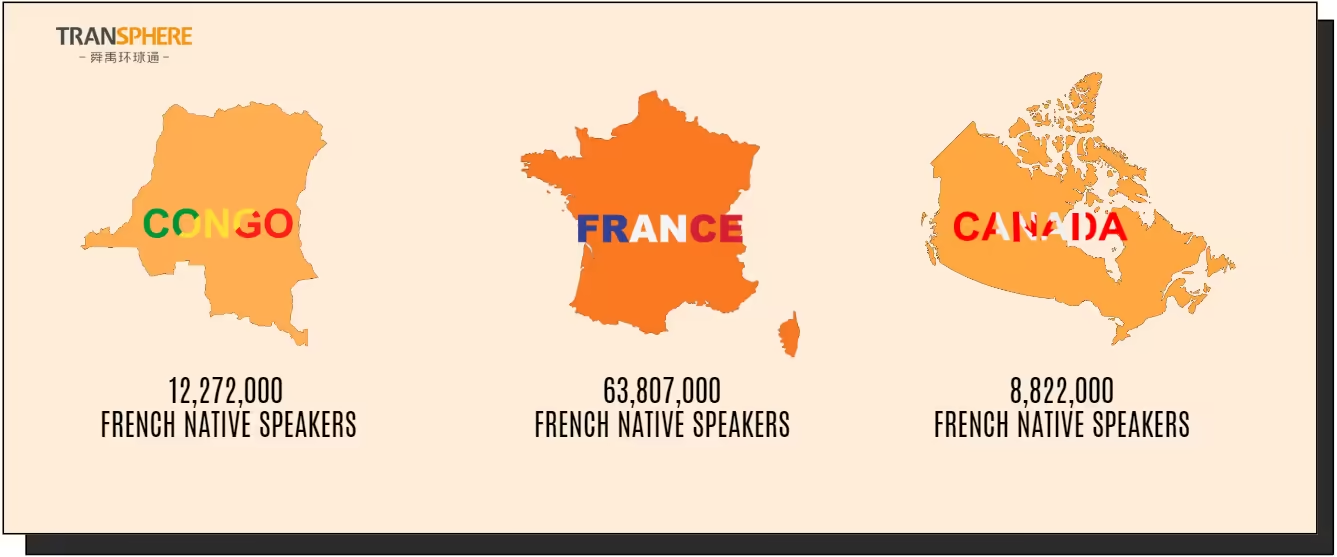
According to World Data, there are 110 million native French speakers across 51 countries. The largest group comes from France, with 63 million natives.
Non-native speakers
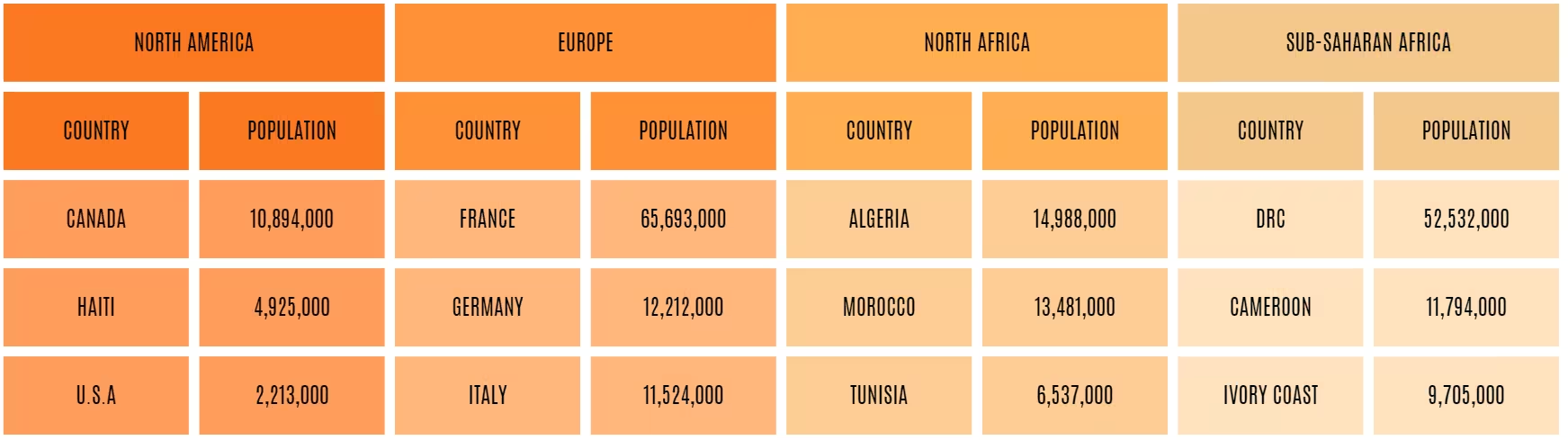
The Observatoire démographique et statistique de l’espace francophone (ODSEF) defines francophones as people who can communicate in French, whether through speaking or understanding, even if they aren’t fully fluent in reading or writing (The French Language in the World, page 21).
By this definition, there are 327 million French speakers worldwide. The majority are in Africa, with the largest populations in the Democratic Republic of Congo, Algeria, and Morocco (81 million combined).
As a side note, remember that these numbers vary slightly depending on which source you pick and how they track the data.
Growth rate
While French is currently the 6th most spoken language globally, it’s also one of the fastest-growing, mainly due to population growth in African nations.
- 6 of the top 10 fastest-growing countries are French-speaking African nations and are expected to nearly double their populations.
- The Organisation internationale de la Francophonie (OIF) predicts that by 2050, the French-speaking community will grow to 700 million people.
- This growth will be driven by young populations, with 90% of the world’s youth expected to come from this segment, according to the ODSEF.
For the gaming industry, this demographic shift is crucial. As the youth population increases, the value of French game localization rises substantially.
How many French-speaking gamers are there?
There are approximately 120 million French-speaking gamers worldwide, spread across four key regions: Europe, North America, North Africa, and Sub-Saharan Africa.
Europe
More than 74 million gamers come from Western Europe, with France and its neighboring countries being the largest contributors. Gamers aside, French localization enables you to tap into the French market and its $4 billion of yearly revenue.
North Africa and the Middle East
There are 17.5 million French-speaking gamers in this region, mostly residing in North Africa. Morocco, Algeria, and Tunisia represent 84.4% of this market, and they may be ideal targets due to their similar socioeconomic status.
Together, they bring in around $658 million annually, reflecting the region’s economic potential for game purchases, even if the per capita revenue isn’t as high.
Sub-Saharan Africa
There are 16.7 million potential gamers in this region, coming mostly from West and Central Africa.
But while these markets are growing, they remain small in terms of revenue. Even when combined, the top 10 largest French-speaking nations in this region generate only about $324 million per year, averaging $32.4 million per country.
North America
North America is the home of 11.5 million French-speaking gamers. Of these, the majority reside in Quebec.
In terms of revenue, the Canadian gaming market is thriving, generating over $4.3 billion yearly. However, this figure represents all of Canada, not just Quebec.
These four regions represent the largest concentrations of French-speaking gamers, but there are also smaller groups, totaling around half a million gamers across other regions, including South America, Asia, and Oceania.
It’s worth noting that these numbers are likely conservative, especially for Sub-Saharan Africa, where reliable data is limited.
France remains the king of the hill 👑
Research consistently shows that consumers, including gamers, tend to spend a larger percentage of their income on entertainment (games) when they have more disposable income.
According to The Ascent, the top 20% of earners outspent the lowest earners by a staggering 2,094%. While this study focused on income groups within a single nation, the principle likely holds true on a global scale as well—wealthier nations tend to generate more revenue for game developers.
As such, with 40+ million gamers and an expected yearly gaming revenue of $8.3 billion by 2027, France remains the most lucrative market for French game localization. It’s the ideal starting point for any game translation project targeting French-speaking audiences.
Data limitations and challenges
The assumption problem
The data presented here is based on two key assumptions, both of which introduce certain limitations:
- The percentage of French speakers in any given country is considered an average segment of the population, without accounting for variations in purchasing power (i.e., French-speaking gamers are assumed to spend as much on games as English-speaking gamers).
- The French-speaking population in each country is assumed to have similar consumer habits, meaning they are equally likely to engage in gaming as other language groups.
If future research reveals that these assumptions are incorrect, the data and conclusions provided here will need to be revised accordingly.
The African challenge
Our data suggests a surprisingly low number of gamers in Maghreb and Sub-Saharan Africa. However, it’s crucial to acknowledge that this is likely an undercount due to poor data availability. Since the region’s gaming markets are not as developed, data about the markets’ specifics can be challenging to collect.
Interestingly, even if we were to double our estimated number of African gamers to account for this probable undercount, the overall market assessment would remain largely unchanged.
This is because the economic realities of the region mean that the effective target market (in terms of potential revenue) remains comparatively small. Consider the following factors:
- Economic barriers: Gaming requires disposable income, which is less available in economically challenged areas.
- Market fragmentation: Unlike China’s massive, relatively homogeneous market, Africa’s gaming landscape is more diverse and spread across numerous countries.
- Prevalence of piracy: Lower purchasing power often correlates with higher rates of software piracy.
This doesn’t diminish the potential of the African markets. As their economies continue to develop and digital infrastructure improves, we expect to see not only more accurate data but also a shift in the market’s attractiveness for gaming companies.
Key takeaways
While French may not offer the same ROI as English, it provides access to 120 million gamers, with about 70% coming from wealthier regions with significant spending power. Combined with high growth rates and a strong gaming culture, French game localization remains a valuable investment.