

As the global pharmaceutical market grows, regulators are becoming more demanding about drug registration and market approval. The Common Technical Document (CTD) is the standard format used for regulatory submissions, and it plays a crucial role in global drug registration. This internationally accepted format is used to submit applications for drug approval, covering key information about a drug’s safety, effectiveness, and quality—all of which directly affect approval timelines in different countries.
Accurate and high-quality CTD translation is essential for companies looking to enter new markets. Translating drug registration documents, however, is much more challenging than general technical translations. It requires more expertise from translators and everyone involved in the process.
In this article, we’ll examine the CTD dossier formats, their characteristics, and the qualifications needed for those handling the translation process.
The CTD overview
The CTD was developed by the International Council for Harmonization of Technical Requirements for Pharmaceuticals for Human Use (ICH) to harmonize drug registration requirements across the EU, Japan, and the US.
The CTD standardizes the preparation and presentation of data related to drug development, manufacturing, and clinical trials, significantly simplifying the drug registration process in multiple countries. With its growing popularity, more countries and regions have adopted the CTD format.
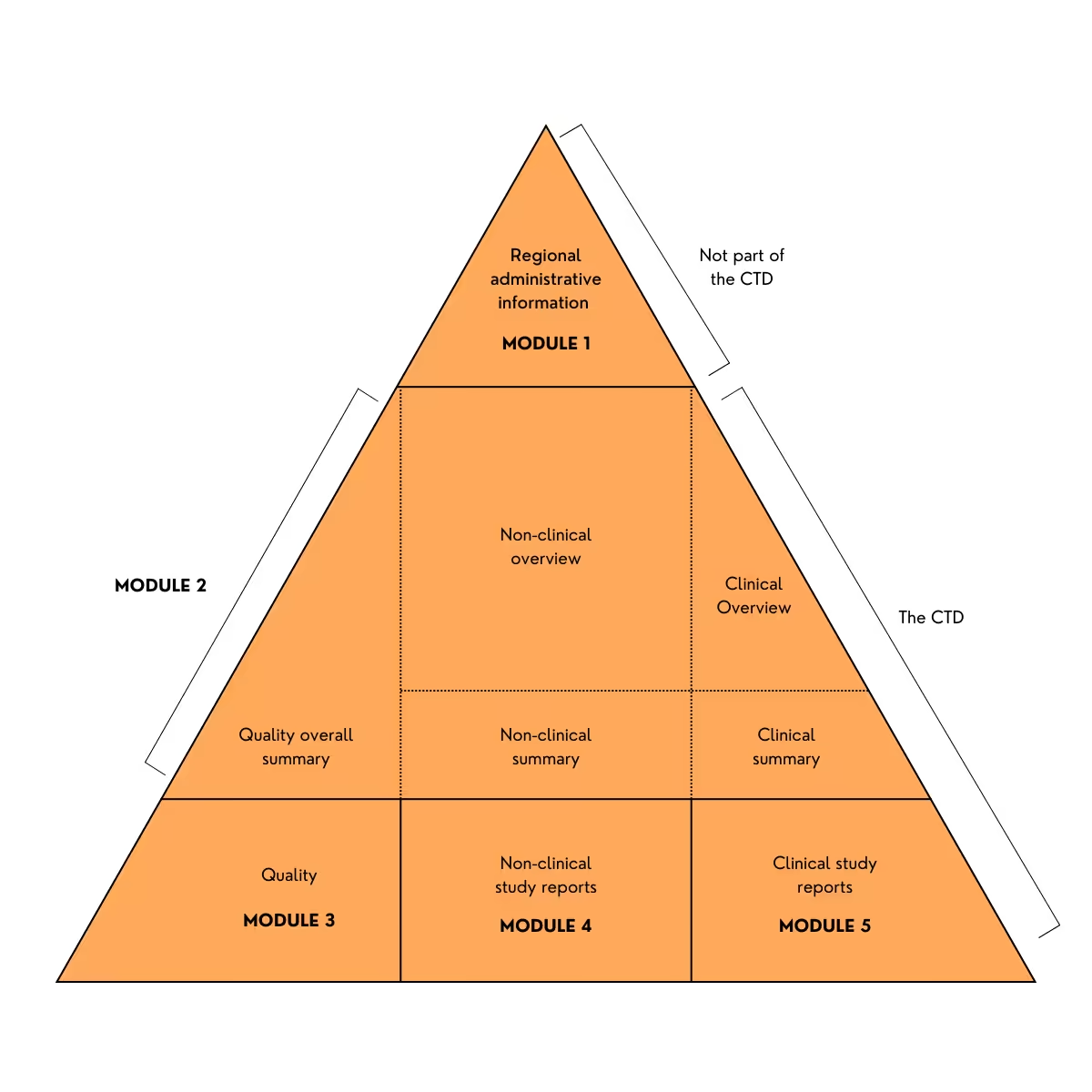
The CTD has become a globally recognized format for preparing well-structured documents submitted to regulatory authorities for drug approval. The image above shows that the CTD is organized into five modules. Module 1 is region-specific, while Modules 2, 3, 4, and 5 are intended to be universal.
- Module 1: Regional administrative information. It contains region-specific documents with content and a format defined by local regulatory authorities.
- Module 2: Summaries. It provides summaries and overviews of the drug’s quality, as well as non-clinical and clinical data.
- Module 3: Quality. It includes detailed information about the drug’s chemistry, formulation, and biological properties.
- Module 4: Non-clinical study reports. It contains data from toxicology and pharmacology studies on the drug substance and product.
- Module 5: Clinical study reports. It includes data from clinical trials of the drug.
Characteristics and requirements of CTD Dossiers
CTD translation differs from other types of technical translation due to its unique characteristics, which place higher demands on both the translators and the companies managing these projects. Key characteristics include:
Highly specialized content
A CTD dossier contains detailed data and analysis on drug-related areas like chemistry, pharmacology, and clinical research. Translating this type of specialized content requires a deep understanding to preserve the complexity and accuracy of the original information. For example, in the pharmacology section, there might be a sentence describing a drug’s mechanism of action:
“The drug blocks cancer cell proliferation by inhibiting tyrosine kinase activity.”
If a translator isn’t familiar with terms like “tyrosine kinase” or “inhibit,” they might misunderstand the meaning, resulting in an unclear or incorrect translation.Similarly, technical terms like “Cmax” and “Tmax” often appear in a CTD dossier. Without knowledge of clinical trial terms, a translator might incorrectly translate them as “CMAX” and “TMAX” or interpret them as “maximum C value” and “maximum T value.” However, they actually mean “peak concentration” and “time to peak concentration.”
These examples highlight that anyone working in CTD translations—whether a translator, editor, or quality assurance specialist—needs not only strong language skills but also a solid grasp of medical, pharmacological, and biological concepts to communicate the technical details accurately.
Compliance
Common technical documentation translations must meet the regulatory requirements of the target market, which can differ between countries. Adjustments may be necessary during or after the translation process. For example:
- In the US, the Food and Drug Administration (FDA) mandates that certain drug trial data be included in the “Summary of Clinical Safety” section in Module 2. In the EU, however, this data might need to be covered in the “Clinical Overview” section.
- Some countries may require additional compliance statements or appendices in the CTD dossier, such as specific proof-of-origin documents.
Translators must be familiar with the regulations and approval processes of the target market to ensure compliance. They must also adapt the translation to meet specific requirements for different countries. Since this can be a complex task, it is usually handled by a team that includes translators, engineers, subject matter experts (SMEs), and regulatory specialists.
Each person focuses on their expertise, working together to ensure the final product is accurate and compliant. Experienced professionals understand their role and how to collaborate effectively with others.
The CTD dossier format requirements
The CTD dossier structure is highly standardized. It must strictly comply with both international and country-specific regulations. Below are a few examples of these requirements:
- Each CTD module’s content must be arranged in a specific order. For instance, in Module 3, the manufacturing process section must immediately follow the section on raw material quality standards. The translated version must preserve this exact structure.
- Every chapter and subchapter in the dossier must have clear numbering and titles. Translators unfamiliar with CTD formatting could easily misplace or omit these numbers, leading to a submission that does not meet regulatory standards.
- The “3.2.S Drug Substance” section in Module 3 must follow the prescribed chapter structure exactly. If the order or numbering is incorrect, reviewers may have difficulty finding the necessary information quickly.
- CTD dossiers require page numbers and the document name to appear at the bottom of each page. After translation, the page numbers and document name must be updated to match the translated content. Failure to do so can slow down the review process.
Given these requirements, the CTD translation process must meet the following standards:
- Translators must be familiar with the specific CTD dossier structure and format requirements.
- The right translation tools and workflows must be in place to ensure the translated document matches the original format without disrupting its structure.
- The translated document must be carefully formatted to meet submission requirements.
- Rigorous formatting checks should be conducted to avoid potential structural issues that may delay the review process.
Accuracy
The data and information included in the dossier must be accurate, especially regarding terminology. Translation errors can lead to significant consequences, including the rejection of the entire dossier. Here are some common examples:
- Translation errors with units or decimals can drastically change the meaning of data. If a clinical measure reads “ALT = 45 U/L,” but the unit is mistakenly translated as “U/mL,” or a mean value of “78.6%” is translated as “7.86%,” it could severely impact the document’s validity. These errors often happen when converting scanned files into electronic editable files or when relying excessively on CAT tools without adequate review.
- Another common issue is misinterpreting technical terms. For example, “disintegration time” should be translated as “崩解时间”, but a translator unfamiliar with the technical term might incorrectly translate it as “崩散时间” (dispersal time). Similarly, “nitroglycerin” must be translated as “硝酸甘油”, not “硝化甘油”.
Maintaining accuracy requires vigilance at every stage:
- Translators must carefully review their work to identify and correct errors.
- Project managers should leverage third-party tools to detect potential issues.
- Technical expertise and experience are essential; experienced teams are much better at ensuring accuracy.
- Maintaining an up-to-date glossary of industry-specific terminology is vital. Terminology evolves, and outdated translations can create issues during dossier reviews.
Consistency
During the CTD translation, it is essential to ensure that the same terms are translated consistently across both the same document and different documents. For example:
- Drug name consistency: If the word “Aspirin” appears in both Module 2 and Module 3 but is translated as “阿司匹林” in Module 2 and “乙酰水杨酸” (acetylsalicylic acid) in Module 3, it could confuse reviewers and undermine trust in the dossier.
- Unit consistency: If the drug dosage unit is “mg” in one module and “milligram” in another, even though they refer to the same thing, it could lead to confusion and misunderstandings.
- Terminology formatting consistency: If different versions of the term “CTD” appear in the translation, as shown below, readers might be confused:
- CTD
- Common Technical Document
- 通用技术文档
- 通用技术文档 (CTD)
- CTD (通用技术文档)
The following practices are recommended to maintain consistency:
- Translators should be detail-oriented and provide meticulous translations.
- Terminology management tools, CAT tools, and a systematic terminology management mechanism should be used to ensure that terms and phrases remain consistent.
- A style guide should be created and followed to standardize the translation of abbreviations, measurement units, and metric or imperial units. Custom quality assurance tools should be used to ensure consistency.
Timeliness
Drug registration is a complex process with strict deadlines. As such, the CTD translation process requires a quick turnaround to match these timelines.
If regulators request additional materials on short notice during the drug registration process, translators need to respond quickly and deliver high-quality translations.
For example, a pharmaceutical company might need to provide extra non-clinical toxicology data within a week of submitting the CTD dossier in Europe.
Additionally, some drugs may need expedited approval in urgent cases. Translators must complete the translation of the corresponding CTD documents swiftly to meet the requirements for fast-tracked approval.
To ensure timeliness in translation, it’s important that:
- Translators maintain a high-quality standard while meeting daily output targets and managing their time efficiently, even under pressure.
- The translation team has backup personnel ready to handle urgent requests, ensuring the process remains smooth, even when tight deadlines arise.
Confidentiality
Maintaining confidentiality is critical when translating a CTD dossier. These documents contain highly sensitive drug-related information, such as formulas, research data, clinical trial results, and manufacturing processes.
If such data were to be leaked before approval, it could have serious consequences for the pharmaceutical company and the public. As such, robust confidentiality measures are essential.
Human-caused leaks can happen unintentionally or intentionally. For instance, a translator might unknowingly share sensitive details on public forums when seeking assistance or use insecure methods for transferring data.
On the other hand, some individuals might intentionally disclose confidential information to gain prestige by associating with a well-known client. In worst-case scenarios, they may intend to sell sensitive details to competitors.
Systemic information security risks can also arise when pharmaceutical companies outsource CTD translations without thoroughly vetting the security systems of their translation partners. If the translation company lacks adequate security protocols, sensitive data could be intercepted or leaked, leading to potential leaks.
To prevent these risks, both translators and companies must prioritize information security. Translators must stay aware of best practices and uphold a high level of professionalism to ensure confidentiality. Meanwhile, companies handling CTD translations should implement the following measures:
- Data encryption and secure transmission protocols.
- Access control and permissions management.
- Mandatory signing of non-disclosure agreements (NDAs) by all personnel.
- Security training.
- Regular security audits.
Multidisciplinary content
Common technical documents (CTD) include information from a range of disciplines, requiring translators to have a solid interdisciplinary background and the ability to understand complex content. Here are some typical examples:
- Non-clinical trial data in a CTD dossier include toxicology studies on drugs. Translators must understand animal study results to translate this content correctly. For instance, the phrase “大鼠在高剂量暴露下表现出肝脏毒性” could be mistranslated as “Mice showed liver poisoning under high toxicity exposure” if the translator lacks knowledge of toxicology and animal studies. The correct version is “Liver toxicity was observed in rats at high doses.”
- The quality module of a CTD dossier contains detailed descriptions of chemical analysis methods, such as “High-Performance Liquid Chromatography (HPLC) is used for quantitative analysis.” Translators must grasp these scientific techniques to convey the meaning accurately and maintain the document’s professional tone.
- Clinical trial data often involves statistical terms such as “relative risk” and “95% confidence interval”. Misunderstanding these terms can result in incorrect translations, leading to misinterpretations that could impact the drug approval process.
The following requirements should ensure the CTD translation is accurate:
- Translators must possess interdisciplinary knowledge to accurately understand and translate content that spans multiple fields.
- Translators must communicate effectively with subject matter experts (SME) across various domains.
- The translation projects should involve SMEs who can answer translators’ questions and offer necessary training.
The Electronic Common Technical Document (eCTD)
The eCTD is the digital version of the CTD. It is used to submit drug registration applications digitally. In addition to containing all the information found in the CTD, the eCTD offers the advantages of electronic document management, including easier searchability, navigation, and version control.
It has become the standard submission format accepted by many pharmaceutical regulators worldwide. While the eCTD simplifies the drug registration and review processes, it also introduces new translation challenges.
The eCTD format
As a structured electronic document, the eCTD must follow strict format requirements, including XML tagging, hyperlinks, and electronic signatures.
For instance, when translating quality control standards in Module 3, translators must ensure that all internal hyperlinks in the translated document navigate to the correct locations, allowing reviewers to find the relevant data quickly.
Links, footnotes, and references in tables or charts must remain accurate and functional to avoid errors or broken links caused by the translation process.
Translators must preserve the document’s format and navigation throughout the translation process. For example, all hyperlinks must continue to work correctly to maintain smooth navigation between modules.
After translation, a thorough review of the formatting is essential to guarantee consistency and usability across the document.
Embedded content
eCTD files often contain complex technical elements, such as embedded multimedia, data tables, and charts. Translators must ensure that these elements are properly handled and displayed in the translated document.
When translating sections that include embedded videos, translators must accurately translate subtitles or descriptions while ensuring that the video format and playback functionality remain unaffected.
For sections with complex tables and charts, translators must ensure that all numbers, units, and descriptions are correctly translated while maintaining the original layout and structure.
Since translators typically do not have expertise in managing multimedia content and complex file formats, a translation team must include specialized technical members responsible for managing embedded content using the appropriate tools and processes.
Version control and tracking
eCTD files allow for version control and revision history tracking, which introduces specific translation and document management requirements.
When translating eCTD files, translators must strictly follow these requirements, ensuring that all modifications and updates are properly recorded and reviewed, thereby improving the reliability and compliance of the files.
Version control and revision history
When parts of a document need to be updated due to changes in the source text, client feedback, or input from reviewers, the translated document must clearly record each modification and its reason. This process helps maintain the integrity of version-controlled documents, making tracking and reviewing every change easier.
Each modification should be timestamped and clearly marked to allow precise tracking and analysis of the changes when needed.
Compliance
eCTD files must meet both international and country-specific regulations, including those related to electronic signatures and certifications. Consider the following examples:
- eCTD files submitted to the FDA must comply with the 21 CFR Part 11 regulations governing electronic records and signatures. Translators must ensure that all electronic signatures and certification information remain valid throughout translation.
- eCTD files submitted to European regulators must adhere to the EMA’s guidelines for electronic submissions. Translators must be familiar with these guidelines and ensure that the translated document complies with all relevant requirements.
Translators must thoroughly understand their target markets’ electronic document compliance requirements to ensure the translated document passes approval and registration processes. By carefully following these requirements, translators can effectively support drug registration and international market access.
Conclusion
Translators and translation companies involved in eCTD translation projects need the following skills and qualifications:
Translator requirements
- Advanced education and expertise in pharmaceuticals, biomedical sciences, or life sciences.
- A deep understanding of drug regulatory requirements and the CTD format and content.
- Mastery of both the source and target languages, along with excellent writing skills.
- Specialized training and extensive experience in translating highly technical, regulated documents.
- Familiarity with industry-specific terminology, units, abbreviations, and the review practices of regulators.
- Meticulous and patient, able to work efficiently with long, complex documents.
- Capable of researching questions and seeking assistance when needed, with a mindset of continuous learning to stay updated on industry knowledge.
- A strong sense of confidentiality and professional integrity.
- Ability to ensure the accuracy, completeness, and compliance of the translation.
- Familiarity with self-review processes to ensure high-quality and professional translation outcomes.
Translation company capabilities
Project management
Oversight and coordination of the entire translation process to ensure timely delivery, budget adherence, and regulatory compliance.
Subject matter experts (SMEs)
Providing specialized knowledge in pharmaceuticals or biomedical sciences to review the accuracy, consistency, and regulatory compliance of translations.
Translators
Handling the actual translation work, ensuring linguistic accuracy and fluency.
Terminologists
Creating and maintaining glossaries of industry-specific terms to ensure consistency in terminology.
QA Specialists
Conducting thorough reviews of the translated content to ensure compliance with regulatory standards and overseeing the final verification and approval process.
Desktop publishing (DTP) or formatting specialists
Managing the document’s layout, formatting, and visual presentation to ensure consistency with the original content.
With a multidisciplinary team of experts, the translation of CTD can meet high standards of quality, accuracy, and compliance, helping facilitate the registration and approval of drugs in international markets.
If you have any other questions or concerns, feel free to contact us!