
China represents the world’s largest e-commerce market, a prize of exponential growth for global businesses. But tapping into this $5.8 trillion opportunity in 2025 and beyond isn’t about simply translating your website or app. True success in China demands strategic Chinese localization.
This comprehensive guide is your essential roadmap. We’ll navigate the critical localization elements, from mastering linguistic nuances and cultural sensitivities to technical optimizations and navigating complex regulations.
1. The Chinese Language
Businesses must first navigate the region’s linguistic diversity to localize to China effectively.
Spoken Chinese
Mandarin, or Putonghua, is the official language spoken by over 70% of the population. However, China is linguistically diverse, with over 200 dialects across different regions.
Cantonese dominates in Guangdong and Hong Kong, while Shanghainese is prevalent in Shanghai. Businesses must recognize this diversity when tailoring communication strategies, especially for regional campaigns.
For example, in Guangdong, McDonalds often tailors its campaigns by incorporating Cantonese idioms in its advertisements. To connect with local consumers, a popular campaign featured the phrase “好嘢” (hou ye), which means “great” or “awesome” in Cantonese.
Similarly, Hong Kong Disneyland’s promotional materials often use a mix of Mandarin and Cantonese to engage tourists and locals. Their website prominently displays options for both languages, ensuring accessibility and resonance.
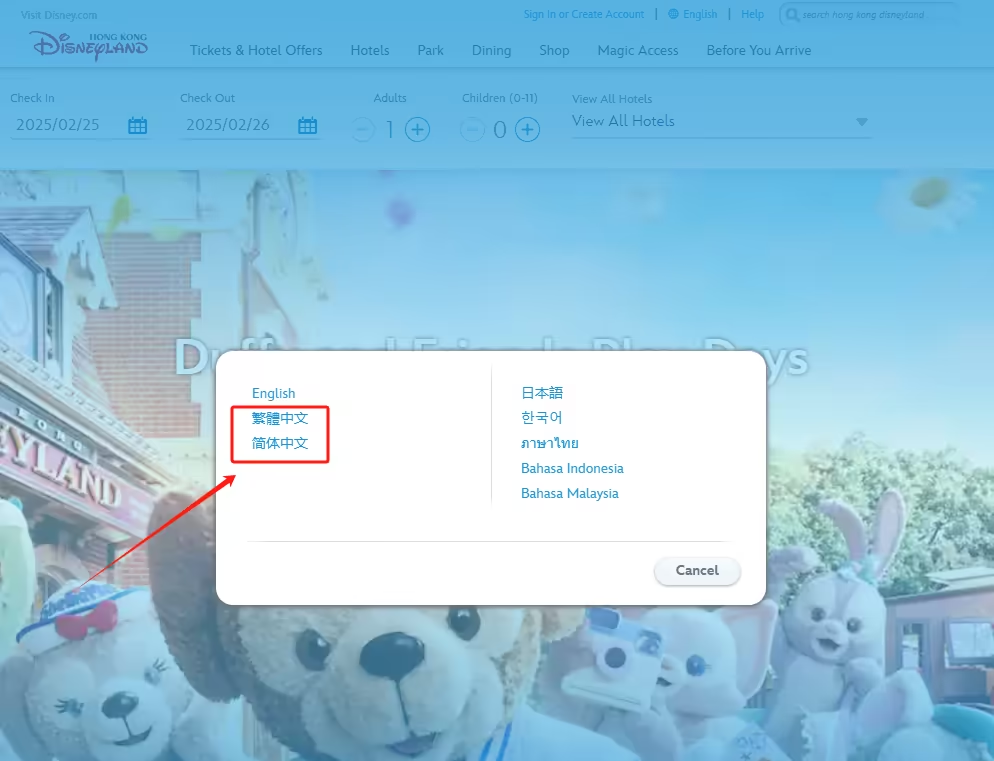
Written Chinese: Simplified vs. Traditional Chinese
Simplified Chinese is the written form used in the Chinese mainland, whereas Traditional Chinese is used in Taiwan, Hong Kong, and Macau. The choice of script impacts legibility and cultural resonance.
For instance, consumers in Taiwan may perceive the use of Simplified Chinese as dismissive of their cultural identity. Localizing content in the correct script is essential for maintaining authenticity and avoiding missteps.
2. Cultural nuances in Chinese localization
Understanding and respecting cultural nuances is key to resonating with Chinese consumers and avoiding missteps that could harm your brand’s reputation.
Numerical significance
Numbers carry profound cultural meanings in China. The number 8 is considered auspicious because its pronunciation resembles “wealth” or “prosperity,” making it a favorite in pricing and phone numbers.
Conversely, 4 is avoided due to its phonetic similarity to “death.” These associations influence consumer preferences and purchasing behavior.
For example, Alibaba’s Singles’ Day sales often feature discounts ending in 8 (e.g., 88 RMB) to attract buyers.
On the other hand, hotels and hospitals frequently omit the fourth floor from their numbering systems. Recognizing these subtleties allows brands to align their strategies with cultural values.
Color symbolism
Colors hold significant emotional and cultural weight in Chinese society. Red symbolizes luck, joy, and celebration, making it ideal for promotional materials and festive campaigns. Gold represents wealth and prosperity, often paired with red during holidays like Chinese New Year.

Conversely, white is associated with mourning, and black is sometimes linked to bad luck. Also, additional attention needs to be paid to black-and-white photos, particularly in packaging or branding, as they are usually used in funerals.
Formal and informal addressing
Hierarchy and respect play critical roles in Chinese communication. Formal addressing often involves the use of honorifics like “您” (nín, a polite form of “you”) and titles such as “总经理” (zǒng jīnglǐ, General Manager), which are suited for professional contexts, luxury branding, and interactions with older or authoritative audiences. This approach emphasizes respect and professionalism.
On the other hand, informal addressing, using casual pronouns like “你” (nǐ, informal “you”) and slang, is effective for engaging younger consumers, casual products, and social media campaigns. For instance, casual terms like “老铁” (lǎo tiě, “buddy”) are popular in youth-focused marketing.
To successfully manage the Chinese localization process, businesses should adapt their tone to match the target audience and platform. They should ensure that formal language is used for credibility and prestige while informal language fosters relatability and approachability.
Balancing these styles enhances cultural alignment and strengthens connections with Chinese consumers.
3. Technical considerations in Chinese localization
Attention to technical details ensures that your localized content is both accessible and appealing to Chinese users.
Character sets
Chinese characters require specific encoding systems like GB2312, GBK, and UTF-8 to display correctly across devices. Ensuring your website or app supports these character sets prevents display errors and enhances user experience.
Text direction and layout
While modern Chinese text is typically written horizontally from left to right, traditional writing styles include vertical writing from top to bottom and horizontal writing from right to left. These formats are still used in specific contexts, such as calligraphy, formal invitations, traditional books, and signage.
For example, traditional tea house signs in China often use a vertical layout with text written from right to left, emphasizing cultural authenticity. Similarly, calligraphic scrolls displayed in museums or temples maintain the vertical and right-to-left format, preserving historical writing conventions.
Additionally, space constraints pose a unique challenge. Chinese characters often convey more meaning per symbol than alphabets, making them visually dense. To maintain readability and visual harmony, designers must balance text density with white space.
Date, time, number formats, name order, and address structures
Chinese localization requires adapting key elements such as date formats, time representation, currency symbols, numerical separators, name order, and address structures.
These adjustments ensure clarity, professionalism, and alignment with the expectations of Chinese users. Below is a detailed breakdown:
| Aspect | China | Other Formats | Example |
|---|---|---|---|
| Date format | YYYY-MM-DD (Year-Month-Day) | MM/DD/YYYY or DD/MM/YYYY |
Chinese: 2024-12-31 Others: 12/31/2024 or 31/12/2024 |
| Time format | 24-hour clock (e.g., 14:00) | 12-hour clock with AM/PM (e.g., 2:00 PM) |
Chinese: 14:00 U.S. format: 2:00 PM |
| Currency symbol | RMB or ¥ placed before the amount | $ or € placed before or after the amount |
Chinese: ¥1,000.50 U.S. format: $1,000.50 |
| Numerical separators | Comma separates thousands; period denotes decimals | Period separates thousands; comma denotes decimals |
Chinese: 1,234.56 U.S. format: 1.234,56 |
| Name order | Family name first, followed by given name | Given name first, followed by family name |
Chinese: 王小明 (Wang Xiaoming) U.S. format: Xiaoming Wang |
| Address order | From largest to smallest (Country, Province, City) | From smallest to largest (Street, City, State, Country) |
Chinese: 中国江苏省南京市鼓楼区中央路123号 U.S. format: 123 Central Rd, Gulou District, Nanjing, Jiangsu, China |
4. Digital marketing
Businesses must tailor their online strategies to local platforms and user behaviors to succeed in China’s unique digital ecosystem.
Social media integration
Chinese social media platforms differ significantly from Western counterparts in terms of functionality and audience engagement. Below is a table summarizing their key differences and use cases to help businesses tailor their content effectively:
| Chinese Platform | Western Counterpart | Primary Functions | Key Use Cases |
|---|---|---|---|
| WeChat (微信) | WhatsApp + Facebook | Multifunctional platform integrating messaging, social media, e-commerce, and mini-programs | Brand communication, customer service, e-commerce, loyalty programs |
| Douyin (抖音) | TikTok | Short-form video platform with advanced algorithms for content discovery and personalized recommendations | Influencer marketing, viral campaigns, product discovery |
| RED (小红书) | Instagram + Pinterest | Social commerce platform focusing on lifestyle, product reviews, and influencer-driven content | Product discovery, user-generated content, micro-influencer collaborations |
| Weibo (微博) | Microblogging platform for trending topics, news dissemination, and public engagement | Brand announcements, event promotions, crisis management | |
| Bilibili (哔哩哔哩) | YouTube | Video-sharing platform popular among Gen Z for entertainment, gaming, and educational content | Long-form video marketing, niche community engagement |
| Zhihu (知乎) | Quora | Q&A platform for knowledge sharing and expert opinions | Thought leadership, industry insights, product Q&A |
Search engine optimization
Unlike most markets dominated by Google, China’s search engine ecosystem is led by Baidu, which controls over 70% of the market. However, search engine optimization on newer platforms like RED and Douyin are increasingly influential in driving visibility and conversions.
Businesses should optimize their presence across these platforms by integrating localized keywords and customers’ preference-centered content. Additionally, leveraging trends on these platforms can enhance reach and relevance.
Mobile optimization
China is a mobile-first market, with about 70-80% of internet users accessing the web via smartphones. Mobile optimization involves ensuring fast-loading pages, integrating mobile payment options like WeChat Pay and Alipay, and designing user-friendly interfaces.
E-commerce platforms like JD.com and Taobao thrive on seamless mobile experiences.
5. Legal and regulatory compliance
Navigating China’s regulatory landscape is essential to avoid legal pitfalls and maintain consumer trust.
Content censorship
China’s strict censorship laws require businesses to thoroughly review their content to ensure compliance with local regulations.
Sensitive topics such as politics, religion, national security, and territorial integrity are closely monitored, and even minor oversights can lead to content removal, website bans, or reputational damage.
A frequent issue arises when Hong Kong, Macau, or Taiwan are inaccurately labeled as separate countries in dropdown menus. In the Chinese context, these are considered integral parts of China (Hong Kong and Macau are Special Administrative Regions, and Taiwan is a province).
Misrepresentations, intentional or otherwise, can lead to consumer backlash and government scrutiny. For instance, during a marketing campaign, Dolce & Gabbana faced backlash for perceived cultural insensitivity in their advertisements, resulting in their e-commerce presence being removed from major Chinese platforms.
Another common pitfall involves maps and geographic representations. Maps intended for use in China should include Taiwan as part of Chinese territory and display clear, standard borders for regions like the South China Sea. Using inaccurate or ambiguous maps can result in regulatory penalties.
Practical tips to avoid missteps:
- Verify that maps and geographic materials comply with Chinese standards before publication, particularly for marketing or e-commerce platforms targeting Chinese users.
- Avoid using language or imagery that might imply a stance on politically sensitive topics, especially regarding territorial issues.
By understanding these cultural and regulatory nuances, businesses can localize their content effectively while maintaining compliance and protecting their reputation in the Chinese market.
Key takeaways
Chinese localization is a critical investment for businesses seeking success in the Chinese market. By understanding linguistic diversity, respecting cultural nuances, optimizing for local technology, and complying with regulatory standards, companies can unlock the full potential of this dynamic economy.
The process may require time and resources, but the payoff—higher engagement, trust, and conversions—is well worth the effort.
Should you encounter any localization questions, please don’t hesitate to contact our team of professionals. As a China-based LSP, we’re expertly positioned to guide you through any challenges. Our priority is your successful entry and expansion into the Chinese market.