

Summary: Quotations are complex because vendors operate differently. But, looking beyond their stated translation cost per word can show the true value of a proposal (both good and bad).
In fact, “cheaper” bundled rates can mask the absence of key technical and quality assurance steps. As such, itemized quotes are the safer choice for complex projects, despite what may seem as undue complexity.
For newcomers, and sometimes even veterans, translation quotes can be hard to decipher. They either seem to come with an endless list of items or a straightforward bill. But, complexity aside, they often vary substantially from one vendor to another. So it begs the question, why?
Well, it’s because localization processes are complex, and translation costs per word are often just one part of the full picture.
Our goal here is to provide you with a practical example that can help you assess the different types of quotations you may receive and how to decipher them. Oh, and an extra checklist to use in your next vendor negotiations.
A real-world localization quote example and why it varies
Let’s examine a case involving Michael, a product manager. Recently, his company’s management team decided to market the product he oversees to global audiences.
This well-established and English-created product is now set for international expansion. The purchasing department recommended three suppliers for the localization process.
Michael held discussions with each supplier, providing them with the following details and requirements for localization:
- The product is a software.
- The text requiring translation includes:
- 30,000 words from the user interface
- 200,000 words from help documents and manuals
- 10,000 words from the product promotion materials and webpage
- The target languages are French, German, Japanese, Spanish, and Simplified Chinese.
Subsequently, the three suppliers submitted their quotations. These quotations differed significantly in translation costs and in the scope and types of work included, leaving Michael confused and uncertain about which was most suitable.
The first quotation focused largely on a translation cost per word and language:
| Language | Price | Unit | Word count | Cost |
|---|---|---|---|---|
| French | $0.16 | Word | 240,000 | $38,400.00 |
| German | $0.17 | Word | 240,000 | $40,800.00 |
| Spanish | $0.15 | Word | 240,000 | $36,000.00 |
| Japanese | $0.20 | Word | 240,000 | $48,000.00 |
| Simplified Chinese | $0.09 | Word | 240,000 | $21,600.00 |
| Total | $ 184,800.00 | |||
The second quotation introduced the concept of workload as well as hourly units:
| Category | Language | Price | Unit | Workload | Cost |
|---|---|---|---|---|---|
| UI Translation | French | $0.17 | Word | 30,000 | $5,100.00 |
| German | $0.18 | Word | 30,000 | $5,400.00 | |
| Spanish | $0.16 | Word | 30,000 | $4,800.00 | |
| Japanese | $0.22 | Word | 30,000 | $6,600.00 | |
| Simplified Chinese | $0.10 | Word | 30,000 | $3,000.00 | |
| Sub-total | $24,900.00 | ||||
| UA Translation | French | $0.15 | Word | 200,000 | $30,000.00 |
| German | $0.16 | Word | 200,000 | $32,000.00 | |
| Spanish | $0.14 | Word | 200,000 | $28,000.00 | |
| Japanese | $0.20 | Word | 200,000 | $40,000.00 | |
| Simplified Chinese | $0.08 | Word | 200,000 | $16,000.00 | |
| Sub-total | $146,000.00 | ||||
| Marketing Translation | French | $0.18 | Word | 10,000 | $1,800.00 |
| German | $0.19 | Word | 10,000 | $1,900.00 | |
| Spanish | $0.18 | Word | 10,000 | $1,800.00 | |
| Japanese | $0.24 | Word | 10,000 | $2,400.00 | |
| Simplified Chinese | $0.12 | Word | 10,000 | $1,000.00 | |
| Sub-total | $9,100.00 | ||||
| Localization Engineering | Pre-translation | $20.00 | Hour | 4 | $80.00 |
| Post-translation | $20.00 | Hour | 10 | $200.00 | |
| Sub-total | $280.00 | ||||
| Total | $180,280.00 | ||||
| Tax | 5% | $9,014.00 | |||
| Grand Total | $189,294.00 | ||||
The third quotation introduced management fees:
| Category | Language | Price | Unit | Workload | Cost |
|---|---|---|---|---|---|
| Team Preparation | $45 | Hour | 8 | $360.00 | |
| UI Translation | French | $0.17 | Word | 30,000 | $5,100.00 |
| German | $0.18 | Word | 30,000 | $5,400.00 | |
| Spanish | $0.16 | Word | 30,000 | $4,800.00 | |
| Japanese | $0.22 | Word | 30,000 | $6,600.00 | |
| Simplified Chinese | $0.10 | Word | 30,000 | $3,000.00 | |
| Sub-total | $24,900.00 | ||||
| UA Translation | French | $0.15 | Word | 200,000 | $30,000.00 |
| German | $0.16 | Word | 200,000 | $32,000.00 | |
| Spanish | $0.14 | Word | 200,000 | $28,000.00 | |
| Japanese | $0.20 | Word | 200,000 | $40,000.00 | |
| Simplified Chinese | $0.08 | Word | 200,000 | $16,000.00 | |
| Sub-total | $146,000.00 | ||||
| Marketing Translation | French | $0.18 | Word | 10,000 | $1,800.00 |
| German | $0.19 | Word | 10,000 | $1,900.00 | |
| Spanish | $0.18 | Word | 10,000 | $1,800.00 | |
| Japanese | $0.24 | Word | 10,000 | $2,400.00 | |
| Simplified Chinese | $0.12 | Word | 10,000 | $1,000.00 | |
| Sub-total | $9,100.00 | ||||
| Localization Engineering | Pre-translation | $20.00 | Hour | 4 | $80.00 |
| Post-translation | $20.00 | Hour | 10 | $200.00 | |
| Sub-total | $280.00 | ||||
| Multimedia Localization | French | $20.00 | Hour | 16 | $320.00 |
| German | $20.00 | Hour | 16 | $320.00 | |
| Spanish | $20.00 | Hour | 16 | $320.00 | |
| Japanese | $20.00 | Hour | 16 | $320.00 | |
| Simplified Chinese | $20.00 | Hour | 16 | $320.00 | |
| Sub-total | $280.00 | ||||
| Localization Testing | French | $38.00 | Hour | 30 | $1,140.00 |
| German | $40.00 | Hour | 30 | $1,200.00 | |
| Spanish | $35.00 | Hour | 30 | $1,050.00 | |
| Japanese | $50.00 | Hour | 30 | $1,500.00 | |
| Simplified Chinese | $20.00 | Hour | 30 | $600.00 | |
| Sub-total | $5,490.00 | ||||
| Sum | $187,730.00 | ||||
| Project Management | 10% | $18,773.00 | |||
| Total | $206,503.00 | ||||
| Tax | 5% | $10,325.15 | |||
| Grand Total | $216,828.15 | ||||
So while they may seem similar, each translation quotation creates complexities and significant price differentials.
The following sections will delve deeper into how to effectively analyze and compare these differing quotations to make an informed decision.
The breakdown of translation cost per word and service fees
Analyzing translation services costs by language
Translation is fundamental to any localization project. It involves converting source material—text, audio, or video—from one language to another while preserving the original intent, style, tone, and context.
From the quotations Michael received, it is evident that translation costs constitute most of the total expense. Typically, translation expenses account for over 70% of the total cost of a new product localization project.
Pricing variations across language pairs
The industry typically charges a translation cost per word. It can vary significantly depending on the language pair involved. Languages with fewer qualified translators or higher living costs may be priced higher.
In Michael’s case, the cost of translating into Chinese is notably lower than that of other languages.
Translation workflow
To ensure quality, translations typically follow a predefined workflow, such as TEP (Translation, Editing, Proofreading) or TR (Translation, Review).
Different workflows imply different pricing structures. However, vendors often do not itemize translation into these steps in their quotations, meaning the prices reflect the entire workflow agreed upon by both parties.
As a buyer of localization services, it’s also important to discuss the expected quality of the translation with vendors, thereby clarifying that the prices in the quotation reflect the cost of achieving this expected quality.
Additionally, to ensure the vendor meets the expected translation quality, it’s advisable to establish a separate workflow to check translation quality, usually performed by a third-party vendor.
This introduces an additional localization cost. The buyer should inquire about review or QA pricing from this third-party vendor.
Content-specific translation
In the first quotation Michael reviewed, there is a single translation price for each language. However, in the second and third quotations, translation is categorized into UI translation, UA translation, and marketing translation:
- UI translation refers to the translation of texts displayed in the product’s user interface, such as menus, buttons, error messages, etc.
- UA (User Assistance) translation involves documents, help, guides, and tutorials that assist the users.
- Marketing translation includes website content, brochures, and other materials to promote the product.
These different types of content have varying uses and complexities. For instance, website projects often involve complex pricing tiers for UI strings versus marketing copy. Check our guide on this very topic here.
In the first quotation, the vendor combined all translation services into a single package price, which is also feasible. This method can simplify decision-making but may limit the ability to tailor services to specific needs.
How localization engineering affects your technical costs
Localization engineering is crucial in addressing the technical aspects of localizing a product. This facet of localization involves several key activities performed by localization engineers before and after the translation process.
Pre-translation activities
Before translation begins, localization engineers are responsible for converting files from their original format into a format suitable for translation.
This step typically includes locking strings that are not meant to be translated, a measure that helps reduce unnecessary translation costs and prevents issues caused by unintentional translation of non-translatable elements.
Post-translation activities
After the translation is completed, the next step involves converting the translated files back into their original format to be integrated into the creation of the localized software.
Additionally, localization engineers perform technical checks to ensure the translation has been implemented correctly and are responsible for correcting any technical defects related to localization.
Localization engineering is typically charged by the hour, based on the time engineers spend on these activities.
Since engineering tasks are language-independent, all languages have a single engineering price. The workload for localization engineering is usually estimated based on the vendor’s experience, and generally, the cost should represent a small portion of the total project cost.
Vendor capabilities and risks
In the quotations Michael received, the first vendor did not include any costs for engineering or categories other than translation. This omission can indicate that the vendor primarily focuses on translation services and may lack experience handling complex localization projects. Such vendors often consider localization engineering part of the translation process and offer a bundled price.
However, working with such a vendor carries risks due to their limited engineering capabilities. It is only advisable to engage such a vendor if the client is experienced in localization and can manage all non-translation activities independently.
Choosing a vendor with robust engineering capabilities is better for those requiring comprehensive localization services to ensure a smooth and successful localization project.
💡
Does this workflow feel too complex? Let us handle the engineering and project for you.
Beyond translation word count (LQA, Multimedia and PM)
When comparing the third quotation to the second one, we observe more categories included, reflecting a broader scope of work and a reasonable increase in project costs.
Term preparation
Term preparation, also known as terminology management, is an essential preliminary step in localization. It involves identifying, researching, and defining key terms critical to the product to ensure consistency and accuracy across all translated materials.
This task is usually conducted before the main translation phase begins. In Michael’s case, there are no predefined terminologies as the product is being localized for the first time. Experts need to go through the content initially to create a term list, which the client then verifies and approves. Subsequently, these terms are translated and approved.
This entire process should be completed before translation begins, and term preparation is typically charged based on the hours experts spend on term development.
Multimedia localization
Localization extends beyond text to include multimedia elements such as images, videos, and graphics, which often require adjustments to suit the cultural contexts of each target market.
Localizing multimedia content may involve changing visuals, altering layouts, adding subtitles, or re-recording audio with native voice talents.
This requires professionals skilled in graphic design, video editing, and other multimedia technologies, contributing to an increase in the overall project cost.
The third vendor quoted 16 engineering hours per language in the example provided, indicating an anticipated need for multimedia localization. They did not include costs for voice talent, suggesting no audio replacement was necessary. If the client’s expectations differ, they should discuss the multimedia workload further.
Localization testing
Quality assurance is crucial for the success of the localized product. It encompasses linguistic testing to ensure all elements are translated correctly and displayed as expected, functional testing and internationalization testing to verify that all features function in the localized version as they do in the original.
Linguistic testing is typically performed by linguists fluent in the target language, while functional and international testing are usually conducted by technical testers from the client’s team.
Localization testing is charged based on the hours needed for linguistic testing, estimated by the volume of text and UI screens.
Project management
The final component is project management costs, which cover the expenses of project managers and assistants who oversee the localization projects.
Effective project management is critical, especially for complex localization projects. It involves planning, executing, and monitoring all localization activities to ensure the project is delivered on time and meets quality standards.
Project management costs are calculated as a percentage of the total project cost, typically ranging from 5% to 15%.
With these additional categories included, it is evident that the third vendor has a more comprehensive understanding of the localization process. They have identified a broader scope of work and quoted accordingly, resulting in a cost that is 14% higher than the second vendor.
An easy-to-use vendor vetting checklist
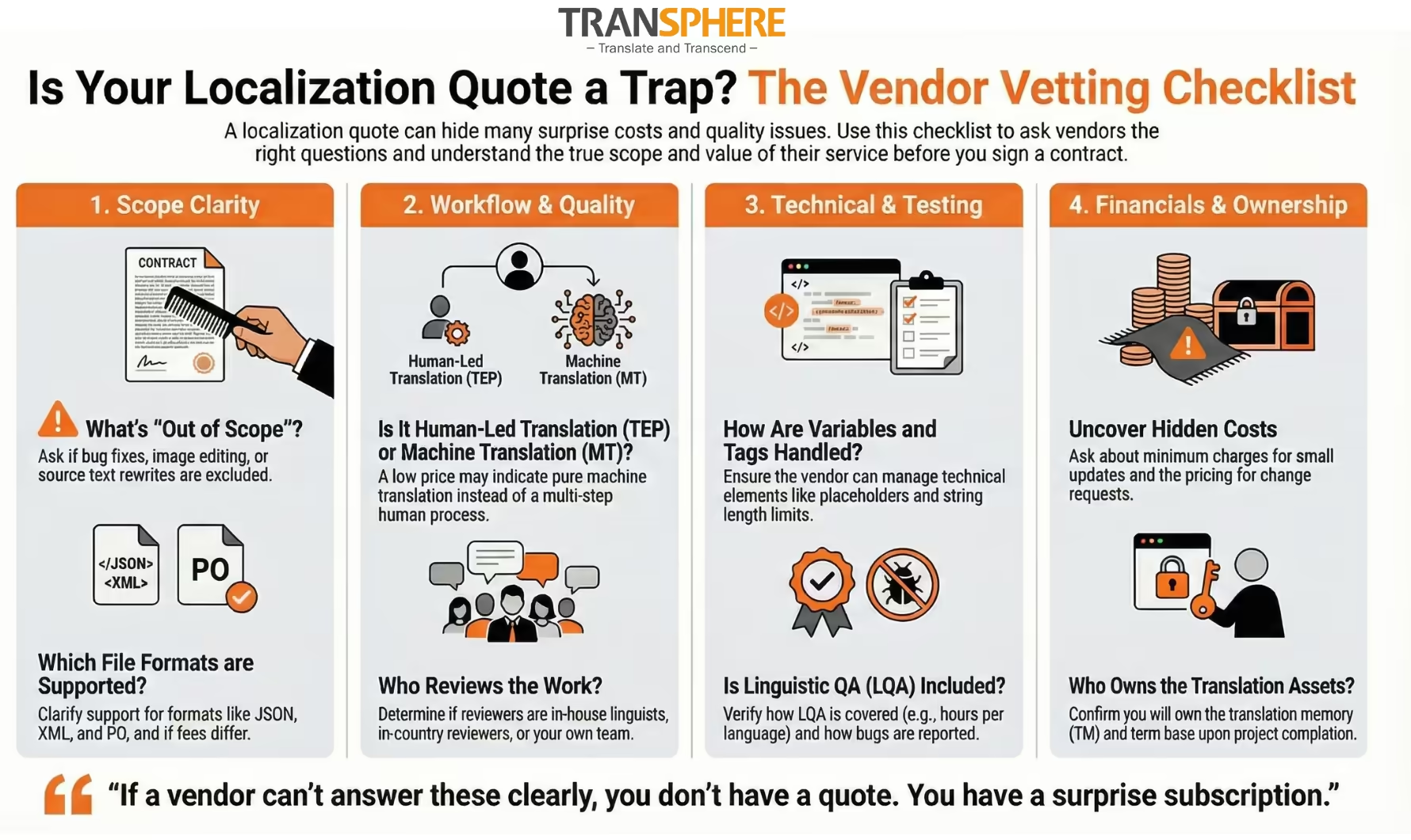
To help you evaluate vendors, we prepared a comprehensive list of questions you shouldn’t shy away from asking. Feel free to copy and paste the relevant ones when emailing vendors.
- Content type: Does the quote include UI, help documentation and marketing copy? Any exclusions?
- File support: Which formats do you support (JSON, XML, HTML, INI, PO, etc.), and do you charge different fees for each format?
- Out of scope: What is considered “out of scope” (bug fixes, UI redesign, image editing, source text rewrites, etc.)?
- The workflow: Is this TEP (Translation + Editing + Proofreading) or just pure translation?
- The price: Your quoted rate is rather low. Is this really MTPE or just MT? How come your rate is that much lower than those of similar competitors?
- Review cycles: How many review cycles are included?
- Review quality: Who is the main reviewer? An in-house linguist, in-country reviewer, or client reviewer?
- Consistency: Is glossary creation and terminology management included? If so, what deliverables can we expect?
- Pre-translation: What engineering tasks or preparatory steps are included in this quote? File preparation, string locking, pseudo-localization, etc.?
- Post-translation: Is rebuilding the translated files back into the source format included?
- Technical implementation: How do you handle placeholders/tags/variables and string length constraints?
- Context: Do we need to provide screenshots and additional context to the translators?
- Coverage: Is linguistic QA (LQA) included? If yes, how many hours or screens per language?
- Bug reporting: How are bugs reported (Jira, spreadsheet)? What is the turnaround time for fixes? And how many are included in this quote?
- Testing scope: Are functional/internationalization (i18n) tests included, or must our team handle them?
- Project management: Is PM billed as a percentage fee or hourly? What does it cover (e.g., scheduling, vendor coordination, reporting)?
- Minimums: Is there a minimum charge per language for small updates?
- Change costs: What is your change request policy (new strings, scope creep, rework)? How is it priced?
- Volume discounts: Do you offer weighted word counts for TM matches (100% vs. Fuzzy)?
- Asset ownership: Do we own the translation memory and term base 100% upon completion?
If a vendor can’t answer these clearly, you don’t have a quote. You have a surprise subscription.
How to negotiate and select the right vendor
Having analyzed the various components of localization quotations, we now have insights into each category and its impact on the overall project. Here are the next steps for moving forward:
Vendor discussions and clarification
Engage in detailed discussions with the vendors about all categories listed in their quotations. The above checklist helps, but it’s not enough.
It’s essential to understand each category’s purpose and expected output, such as how they impact quality. This ensures alignment between both parties and helps avoid misunderstandings or miscommunications during project execution.
Workload estimations and tracking
Beyond wordcount, discuss how the vendors estimated the workload for other categories and inquire about their methods for recording the actual workload during project execution. This conversation will also help ensure alignment and prevent potential issues later in the project.
Vendor selection and negotiation
Select the preferred vendor based on a thorough analysis and discussion. Proceed to negotiate the price with the chosen vendor and aim to reach a mutually agreeable contract. Please ensure the agreement outlines all services, responsibilities, and expectations to avoid future complications.
Addressing a common question: Why not bundle all services into one simple price?
You might wonder why not simplify the process by bundling all categories into a single translation price based on word count, as the first vendor has done. While this approach might seem easier for price comparison, it doesn’t accurately reflect the varied workload across different categories, especially as product updates and changes are made.
For instance, in the initial localization phase, translation might constitute over 85% of the costs due to a large volume of new content needing translation.
However, in subsequent updates where fewer new words need translation, the translation cost could drop to less than 40% of the total costs. In such cases, a single-price model becomes impractical and could lead to either overcharging or under-resourcing.
That’s all for this article. Feel free to reach out if you have any questions regarding localization quotations or need further assistance with your localization project.
We’re here to help you navigate through the complexities of localization to ensure your product effectively reaches global markets.
Key takeaways
- “Per word” is not enough: While translation cost per word is the main driver (typically $0.10–$0.22 depending on language), total costs often include hidden fees like engineering and management.
- “Low cost” can come at a cost: Many low-cost quotes omit project management (10-15%) and localization engineering fees. These often appear later as “surprise” add-ons.
- Itemized vs. bundled: A “bundled” price simplifies the initial quote but makes it harder to negotiate or track costs for future updates. Always ask for an itemized breakdown.
- Workflow affects price: A quote for TEP will be higher than a translation-only quote, but it ensures significantly higher quality. Carefully pick the right quality-to-cost ratio for your project.