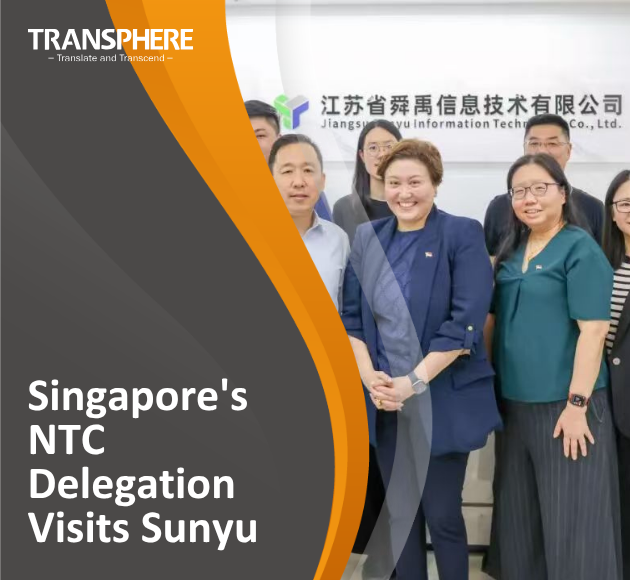
Summary: A delegation from Singapore’s Ministry of Digital Development and Information and National Translation Committee visited Sunyu’s Chengdu office for an exchange on multilingual public communication, translation standards, and technology-enabled language services.
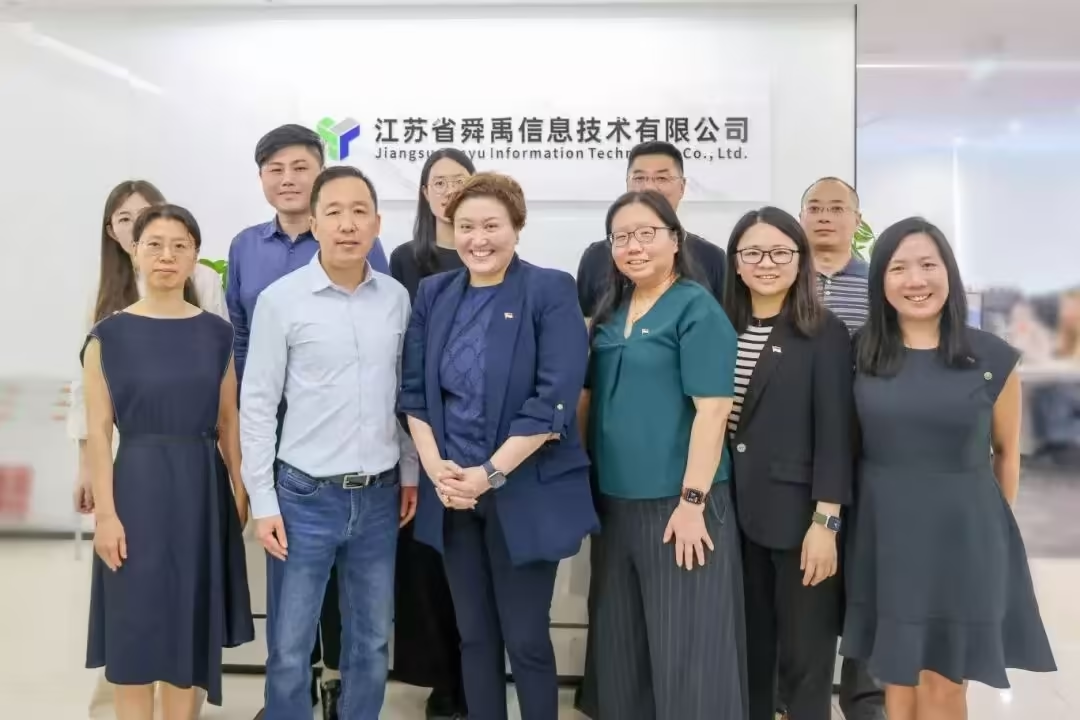
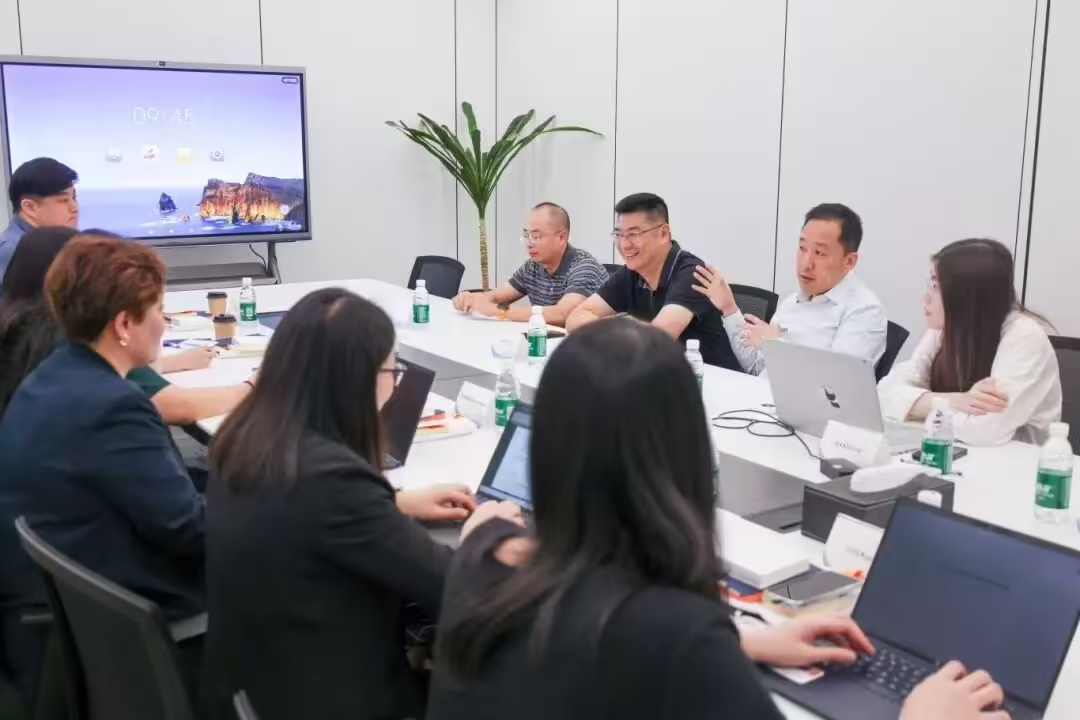
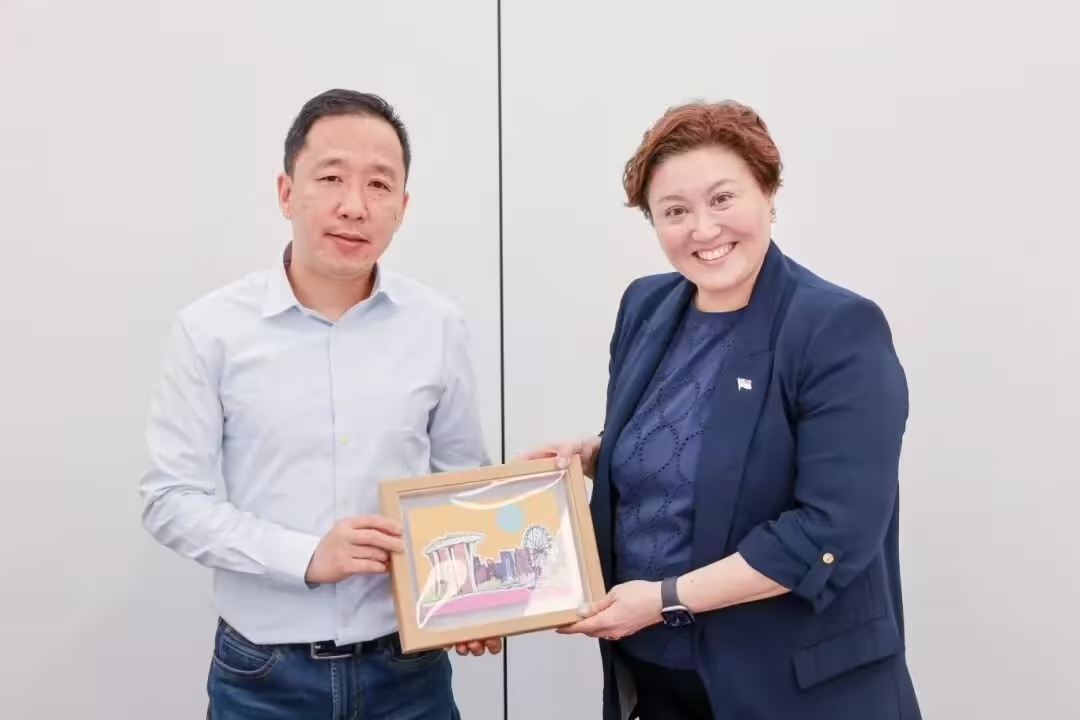
A delegation from Singapore’s Ministry of Digital Development and Information (MDDI) and the National Translation Committee (NTC) recently visited Sunyu’s Chengdu office. The visit was hosted by Sunyu General Manager James Shan (单杰).
The exchange focused on a shared question facing multilingual societies: how can public information move across languages clearly, accurately, and with enough cultural sensitivity to earn trust? For governments, public institutions, and global organizations, translation is not only a language task. It is part of the communication infrastructure that helps people understand policies, services, health information, emergency notices, legal content, and community messages.
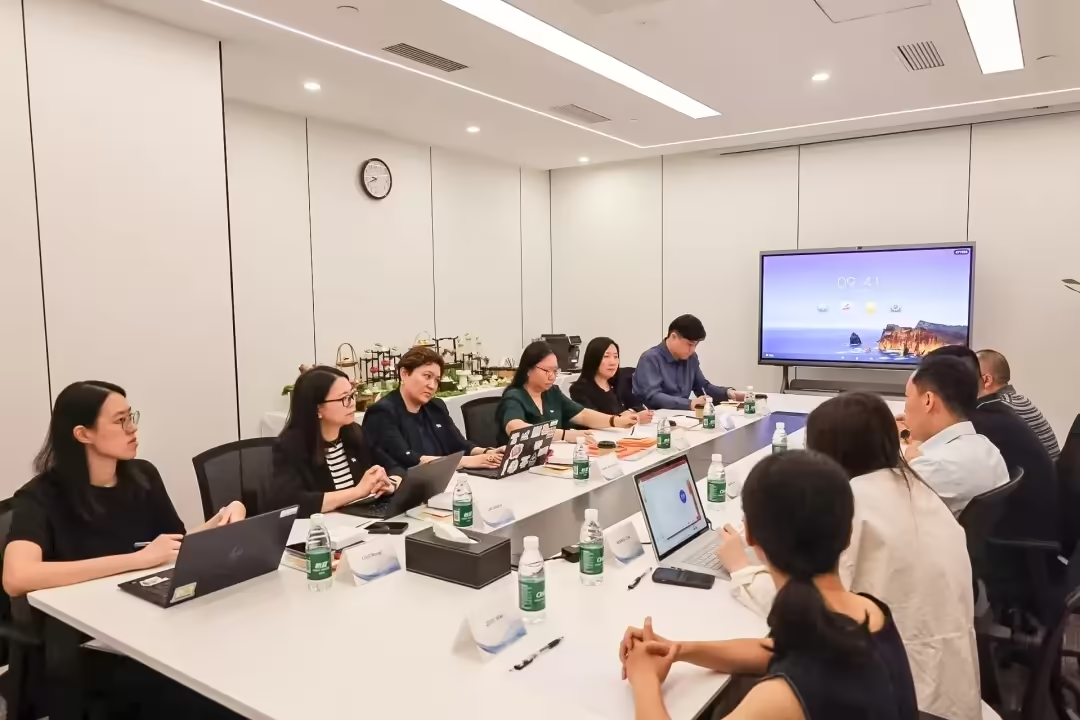
The meeting gave both sides an opportunity to compare how Singapore and China approach language services in multilingual, multicultural environments. The discussion covered translation standards, multilingual public communication, talent development, technology adoption, terminology management, and the operational demands of large-scale interpretation.
Why translation matters in Singapore’s multilingual society
Singapore provides a useful reference point for any discussion about multilingual public communication. The country operates across four official languages:
- English.
- Chinese.
- Malay.
- Tamil.
According to MDDI, its National Translation Committee was established on 1 March 2014 to raise translation standards and strengthen Whole-of-Government translation capabilities across Singapore’s multilingual environment.
The NTC brings together members from the translation and language industries, media, academia, and government. Its work includes promoting best practices for public-sector translation, supporting collaboration among public, private, and people-sector partners, and nurturing the next generation of translation talent.
Singapore’s language landscape also shows why translation remains important even in a highly English-literate society. According to Singapore’s 2020 Census, English became the language most frequently spoken at home among residents aged five and above, rising from 32.3% in 2010 to 48.3% in 2020. At the same time, many English-dominant residents also used a mother tongue language or dialect as a secondary language.
This is one of the central challenges of modern public communication. A common working language can improve efficiency, but it does not remove the need for localized, culturally aware communication. In areas such as public health, legal rights, citizen services, education, finance, and emergency response, people need information in language that feels precise, familiar, and usable.
Singapore’s community translation model
One of Singapore’s most distinctive translation initiatives is the Citizen Translators Project. Led by the National Translation Committee, the project brings members of the public into the translation quality process by allowing volunteers to vet, proofread, and provide feedback on government communication materials.
This approach is important because public communication does not end when a text is translated. A message also needs to be understood by the people it is meant to serve. Community feedback can help identify wording that is technically correct but unnatural, unclear, inconsistent, or unfamiliar to everyday readers.
At the NTC’s 10th anniversary conference, MDDI noted that Singapore had recruited more than 2,500 Citizen Translators, ranging in age from 15 to 88. These volunteers supported government translation efforts, including materials related to Singpass, TraceTogether, and COVID-19 public communication.
For the language services industry, this model offers a useful lesson. Professional translation, machine translation, terminology databases, and community review do not have to compete with one another. When designed carefully, they can work together as a quality ecosystem.
This was one of the themes that made the exchange between the Singapore delegation and Sunyu especially meaningful. Both sides are working within environments where language services must support not only cross-border business, but also public understanding, institutional trust, and multilingual access.
The NTC priorities: community, talent, and technology
The Singapore delegation’s visit also took place against the backdrop of the NTC’s next phase of work. In 2024, the NTC marked its 10th anniversary and outlined three priorities for the years ahead: Community, Talent, and Technology.
Under the Community pillar, the NTC aims to deepen public engagement around translation and bilingualism. This reflects an important principle: translation quality is not only a professional issue. It also depends on how communities understand, use, discuss, and contribute to language in daily life.
Under the Talent pillar, the NTC announced the Translation Industry Workgroup to study Singapore’s translation landscape, review certification programmes, and identify those with potential to serve as a national standard. For language service providers, this points to a wider industry question: how should translation quality be defined, evaluated, and professionalized as client needs become more specialized?
Under the Technology pillar, the NTC announced plans for a Translation Technology Advisory Panel and an upgraded SG Translate 2.0. The goal is not simply to use more technology, but to guide technology adoption in ways that improve translation accuracy, consistency, and accessibility.
NTC priorities and Sunyu capabilities
The exchange between the Singapore delegation and Sunyu was especially meaningful because Singapore’s translation priorities align closely with the operational challenges faced by language service providers across Asia. Both sides are focused on how to make multilingual communication more accurate, scalable, trusted, and future-ready.
| NTC priority | Singapore context | Sunyu relevance |
|---|---|---|
| Community PUBLIC ENGAGEMENT | The NTC engages the public through initiatives such as the Citizen Translators Project, where volunteers provide feedback, vet translations, and help improve public communication materials. Source: MDDI | Sunyu’s work in public-facing multilingual communication shows how language services can support clearer information access for diverse audiences, especially when accuracy and cultural understanding are essential. |
| Talent TRAINING & STANDARDS | The NTC has identified talent development and industry standards as a key pillar, including work to review certification programmes and study international certification frameworks. Source: MDDI | Sunyu’s dual-training model combines client and industry expert input with internal training. Its interdisciplinary teams include professionals with backgrounds in law, medicine, computer science, engineering, and other specialized fields. |
| Technology AI & MT | Singapore has developed SG Translate and SG Translate Together to support localized machine translation, public access, and community feedback. The NTC has also discussed SG Translate 2.0 and the use of large language models to improve contextual accuracy. Source: MDDI | Sunyu’s AI and big-data services, terminology workflows, and localization experience reflect the same industry direction: using technology to improve speed and consistency while keeping expert review at the center of quality control. |
| Standards TERMINOLOGY | Singapore’s Government Terms Translated repository provides standardized translations of more than 7,000 policy-related terms in the country’s four official languages. Source: MDDI | Sunyu’s quality delivery model emphasizes terminology consistency, domain-specific review, professional workflows, and experienced project oversight for high-stakes multilingual content. |
| Public trust ACCESS & CLARITY | The NTC’s work highlights the importance of translation in helping government communication reach citizens who may not be proficient in English, especially during public health and crisis communication. Source: MDDI | Sunyu’s experience in major events, interpretation, IP globalization, and public-facing communication demonstrates how language services help organizations communicate clearly under pressure and across borders. |
Translation technology and public trust
One of Singapore’s most relevant translation technology initiatives is SG Translate Together, a public web portal powered by the SG Translate engine. The portal supports bidirectional localized translation across Singapore’s four official languages: English, Chinese, Malay, and Tamil.
The system is designed for Singapore-specific communication. For example, MDDI has highlighted terms such as “CDC Vouchers,” “Community Centres,” and “Central Provident Fund or CPF” as examples of expressions that require localized handling rather than generic machine translation.
SG Translate Together also allows members of the public to contribute post-edited translations. These contributions can be used to further train the underlying neural machine translation engine, improving the quality of future translations.
This model reflects a broader shift in the language services industry. Translation technology is becoming more powerful, but quality still depends on terminology, context, training data, subject-matter review, and human judgment. In public communication, these details matter because a technically fluent translation can still fail if it uses the wrong policy term, misses local context, or sounds unnatural to the people it is meant to serve.
Terminology management is especially important. Singapore’s Government Terms Translated repository was launched to address inconsistencies in government translation. As of the NTC’s 10th anniversary conference, it hosted standardized translations of more than 7,000 policy-related terms in Singapore’s four official languages.
For organizations working across borders, the lesson is clear: multilingual communication quality cannot rely on translation alone. It requires a full system of glossaries, translation memories, review workflows, style guides, domain expertise, and technology governance.
The translation quality stack
As AI translation tools become more capable, organizations often ask whether technology alone can solve multilingual communication challenges. The experience of public-sector translation suggests a different answer: technology is most effective when it sits inside a larger quality system.
A reliable multilingual communication workflow can be understood as a translation quality stack:
- Clear source content: Translation quality begins before translation. If the original message is vague, overloaded, or inconsistent, the translated version will inherit those problems.
- Terminology databases: Standardized terms help organizations avoid conflicting translations across departments, platforms, and public materials. Singapore’s Government Terms Translated repository, for example, hosts standardized translations of more than 7,000 policy-related terms in the country’s four official languages.
- Translation memory and style guides: Reusable translation assets help maintain consistency across websites, apps, notices, speeches, manuals, policy documents, and event materials.
- Machine translation and AI assistance: AI can improve speed and coverage, especially for first drafts and high-volume content. Singapore’s SG Translate Together portal supports bidirectional localized translation across English, Chinese, Malay, and Tamil.
- Subject-matter review: Specialized content requires reviewers who understand both language and domain logic, whether the topic is law, medicine, engineering, intellectual property, public policy, or emergency response.
- Human editing and cultural review: Editors and reviewers ensure that the final message is not only accurate, but also natural, appropriate, and understandable for its intended audience.
- Community feedback: Public-facing communication benefits from feedback loops. SG Translate Together allows members of the public to contribute post-edited translations, which can help improve future machine translation output.
This stack explains why multilingual communication is best treated as a system rather than a single transaction. A translation may pass a basic language check and still fail if the terminology is inconsistent, the source text is unclear, the cultural context is missing, or the final review does not match the needs of the audience.
Sunyu’s exchange with the Singapore delegation reflected this broader industry direction. The future of language services will not be defined by human expertise or technology alone, but by the ability to combine both into reliable, scalable, and accountable multilingual communication systems.
Sunyu’s role as an IP and language services provider
Interpretation services for the Asian Games and major events
Major international events provide a practical test of multilingual coordination. They require interpretation, translation, staffing, international liaison, terminology preparation, emergency response, on-site communication, media coordination, and rapid decision-making across languages.
Sunyu is the only language service company in Asia to have served four consecutive Asian-level sporting events. Its work has included translation, interpretation, staffing, and international liaison services for events such as the Sanya Asian Beach Games, the Shantou Asian Youth Games, and the Hangzhou Asian Games.
These experiences are relevant beyond sports. The language operations required for major public events closely mirror the capabilities needed in government communication and public emergency response: reaching different communities quickly, using consistent terminology, coordinating multiple stakeholders, and ensuring that important information remains accurate under time pressure.
The Sanya Asian Beach Games, for example, brought together athletes, officials, media, volunteers, and international delegations across a multi-sport event environment. According to China’s State Council Information Office, the 2026 Sanya Asian Beach Games featured 14 sports, 15 disciplines, and 62 events. Source: The State Council of the People’s Republic of China
What China and Singapore can learn from each other
The Singapore delegation’s visit to Sunyu was valuable because both sides approach multilingual communication from different but complementary contexts.
Singapore offers a strong model of public-sector translation planning. Its NTC initiatives show how translation quality can be supported through government coordination, standardized terminology, public participation, bilingualism, talent development, and technology governance.
Sunyu’s experience shows how large-scale language service providers operationalize multilingual delivery across industries, domains, and event environments. Its work combines linguist training, quality management, subject-matter expertise, localization workflows, interpretation management, and technology-enabled service delivery.
Together, these perspectives point toward a shared future for the language services industry in Asia. Translation will increasingly be shaped by AI, but the core challenge will remain human: making information understandable, trustworthy, and appropriate for the communities that depend on it.
Looking ahead
The exchange gave both sides a clearer view of language-services development in China and Singapore, and left room for further dialogue. Sunyu looks forward to continued exchange with MDDI, the National Translation Committee, and peers worldwide, sharing experience and advancing the professionalization, standardization, and internationalization of the language services industry.
Key takeaways
1. Translation is public communication infrastructure: In multilingual societies, translation helps people access information that affects daily life, including government services, public health, legal rights, education, finance, emergency response, and community participation. This makes translation a matter of access, clarity, and trust, not just language conversion.
2. AI translation needs human, domain, and community review: Translation technology can improve speed and coverage, but public-facing communication still depends on human judgment. Singapore’s SG Translate Together model shows how machine translation, public post-editing, localized terminology, and community participation can reinforce one another.
3. Professional standards are becoming more important: As multilingual communication becomes more specialized, organizations need clearer quality benchmarks, stronger training models, and reviewers who understand both language and subject matter. Singapore’s National Translation Committee has identified talent and industry standards as one of its next-phase priorities.
FAQ
Singapore operates across English, Chinese, Malay, and Tamil. Even as English becomes more common in daily life, public communication still requires localized translation so that communities can understand information related to government services, health, education, policy, and emergency response.
Singapore’s National Translation Committee is a committee established in 2014 to raise translation standards and strengthen Whole-of-Government translation capabilities. It includes representatives from the translation and language industries, media, academia, and government.
Singapore operates across English, Chinese, Malay, and Tamil. Even as English becomes more common in daily life, public communication still requires localized translation so that communities can understand information related to government services, health, education, policy, and emergency response.
SG Translate Together is a public web portal powered by Singapore’s SG Translate engine. It supports bidirectional localized translation across English, Chinese, Malay, and Tamil, and allows members of the public to contribute post-edited translations to improve the system. Source: MDDI
Translation technology can improve speed, consistency, and accessibility, especially when supported by localized terminology, trained data, human review, and clear quality workflows. In public communication, technology works best when it supports human expertise rather than replacing it.
Language service providers help organizations deliver information across languages through translation, localization, interpretation, terminology management, editing, review, and multilingual project management. For public-facing content, their work supports clarity, accessibility, and trust.