
- What is Italian, and how many people speak it?
- How many Italian-speaking gamers are there?
- What’s the ideal market for Italian game localization?
- The challenges you may face when localizing your game into Italian.
What is Italian?
Italian is a Romance language from the Indo-European language family. It’s the official language of Italy, San Marino, and Switzerland (among others).
In the European Union, Italian has the second-largest number of native speakers, following German. Beyond Europe, it’s widely learned as a second language, thanks to Italy’s rich cultural influence in opera, art, fashion, and food.
When we talk about Italian, we need to distinguish between:
- Standard Italian (Italiano Standard) – The official, standardized form of the language used in education, media, and formal settings.
- Regional varieties – Many Italians speak regional dialects or local variations in daily life, but they all learn Standard Italian in school. Some of these dialects are so distinct that they can be hard for outsiders, even native Italian speakers from other regions, to understand.
For this blog, when we mention Italian, we’re referring specifically to Standard Italian, not its regional dialects.
How many people speak Italian?
Around 66 million people speak Italian worldwide, making it one of the most widely spoken Romance languages.
However, this number depends on how we count speakers. It is lower if we only count native speakers.
Native speakers
Roughly 62-63 million people speak Italian as their first language, with the vast majority living in Italy (55.5 million). Italian immigrants in the United States form the largest Italian diaspora (2 million).

Non-native speakers
There are about 3 million non-native Italian speakers worldwide. This is a relatively small number compared to other major languages, as Italian is less commonly learned as a second language.
However, thanks to Italy’s strong cultural influence in areas like fashion, cuisine, and art, many people around the world still choose to study it.
How many gamers can you get through Italian game localization
Overall, Italian game localization unlocks up to 30 million Italian-speaking gamers. Once again, they can be split between native speakers and non-natives. The former group is likely more important due to their increased likelihood of playing a game in their native language.
1. Native Italian-speaking gamers
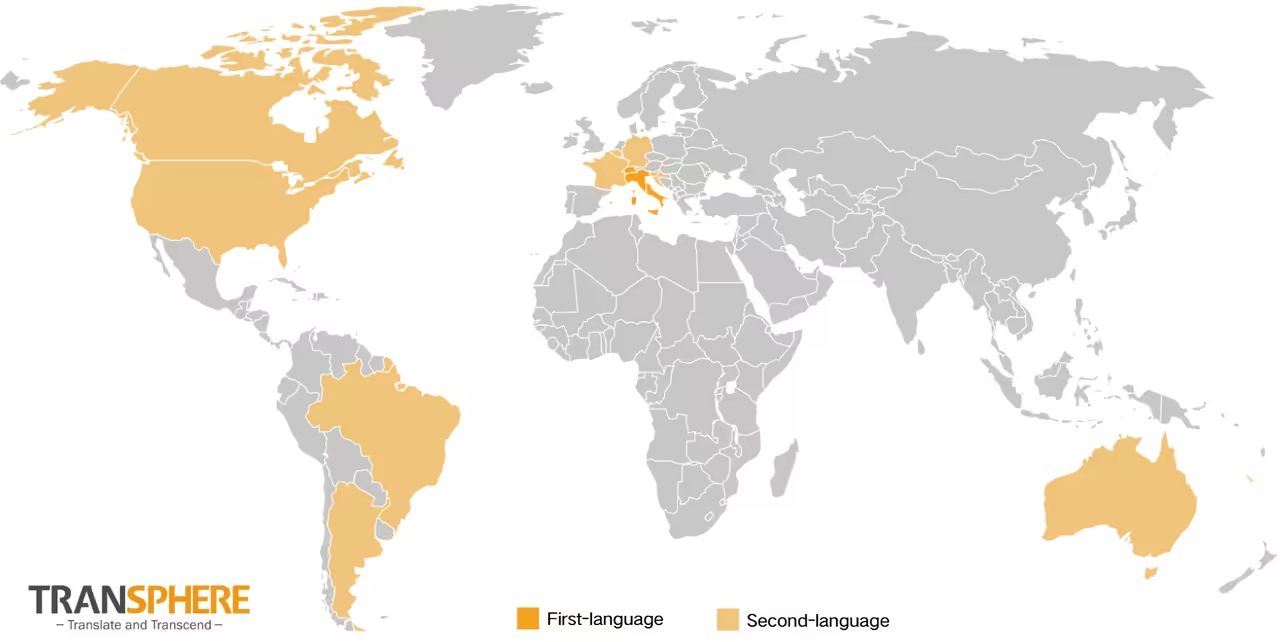
There are about 28 million native Italian-speaking gamers worldwide. Roughly 24.3 million come from Italy. The remaining few come from 9 different countries:
- The U.S.
- Argentina
- Switzerland
- Brazil
- Germany
- Canada
- Australia
- France
- Belgium
2. Non-native Italian-speaking gamers
There are roughly 1.8 million non-native Italian-speaking gamers. It should be noted that this number is tentative. That’s due to the inherent variability of this group.
Some of its members commit to playing their favorite games in Italian, while others may do it temporarily only. They can do it for various reasons, but language learning is one of the most common.
What's the ideal market for Italian game localization?
Italy is the main and strongest market for Italian game localization due to its growing gaming industry and high spending power.
Video game user penetration rate is expected to reach 43.7% by 2025, so we can estimate there will be 25.78 million gamers in Italy in 2025. The market is also expanding steadily, with a projected 6.56% CAGR from 2025 to 2029.
While relatively small compared to some major markets, the Italian market is the home of one of the highest-spending gamers. In fact, they boast a strong ARPU of $959.7.
According to IIDEA, the industry grew 5% annually, was worth $3.6 billion in 2022 and is expected to reach $6.4 billion in 2025.
With strong growth and high player engagement, Italian game localization is a revenue-maximizing strategy worth considering. But to tackle this process well, you must understand Italian gamers and how they like to play.
The Italian gamer
Spending power aside, we can highlight three core characteristics of the Italian gamer:
Age and gaming time
In Italy, 31% of the population between the ages of 6 and 64 plays video games, with the most concentrated age group being 15-24 years, accounting for around 3.2 million gamers. Interestingly, the 45-64 age group also represents a strong portion of the gaming market, with about 3.1 million players.
Italian gamers tend to be loyal, with millennials leading in gaming frequency, followed closely by Gen Z and Zillennials. On average, Italians play 4.1 times weekly, accumulating 17.5 monthly play sessions. This consistent engagement suggests that winning an Italian gamer today could lead to long-term customer loyalty.
Gender
In Italy, the gaming market is male-dominant, with 61% of gamers identifying as such, leaving only 38% of female gamers. However, the number of female gamers has been steadily growing, and they now represent a significant portion of the gaming population.
Platform preference
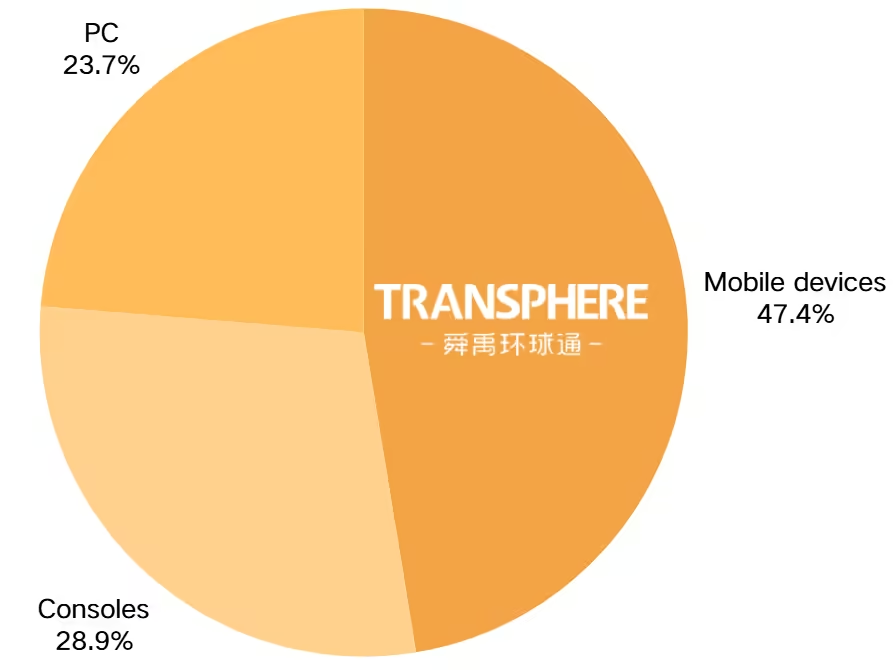
Like most modern markets, mobile gaming dominates in Italy. However, consoles and PCs have a relatively even market share for triple-A gaming.
- Mobile devices: 9.2 million gamers. Primarily play puzzles, trivia, and role-playing/strategy games.
- Consoles: 5.6 million gamers. Mostly enjoy sports, racing, and shooting games.
- PC: 4.6 million gamers, focusing on strategy, shooting, and sports games.
An interesting trend is the growing popularity of Nintendo among players who primarily use PlayStation, Xbox, or PC. Its portability makes it a popular second choice, allowing gamers to play while traveling or commuting.
The Italian market
The Italian gaming market continues to grow and is expected to reach $6.4 billion in revenue by the end of 2025. That being said, to assess the value of this market relative to your game sales, we need to look at the market’s total game sales and in-game purchases.
Software sales
Game software is the most important part of Italy’s gaming industry, making up 71% of the total market. In 2023, they were valued at $1.73 billion, with a 6% increase in new game purchases compared to 2022.
Interestingly, despite the rise of digital sales, physical game sales remain strong. In 2023, video game retail sales generated $286 million, making up 46% of total software sales.
In-Game Purchases (IAP)
IAP saw a 42% decline in 2023, with an estimated value of $309 million. However, the gaming industry remains healthy, with a 28% growth since 2019.
Italian gamers remain passionate about gaming, and while recent years brought unusual market conditions, a more stable trend is expected in 2025.
The challenges of Italian game localization
The Italian market and language bring along some interesting challenges that crop up during the localization process. These challenges can be categorized as technical, linguistic or regulatory.
Technical challenges
Italian words are often longer than their English counterparts, which can create UI challenges. For example:
- “Save” → “Salvare” (+3 characters)
- “Settings” → “Impostazioni” (+7 characters)
Longer translations can also impact subtitles and dialogue boxes. Consider the example below:
English: “I have completed the task.”
Italian: “Ho portato a termine il compito.”
While these differences may seem minor, they can easily compound and break your game. The subtitles won’t align with the voice-over’s timing, the text could overlap with each other, or some design elements could be broken.
Linguistic challenges
In English, we rarely change how we speak based on the person we talk to. But in Italian, there is a clear distinction between formal and informal language, where different pronouns, verbs, and phrases are used depending on the relationship or situation.
The most noticeable difference between formal and informal Italian is the use of the pronouns “Tu” and “Lei”, both meaning “you”:
- Tu (informal) → Used with friends, family, peers, children, or casual and relaxed situations.
- Lei (formal) → Used with elders and authority figures, in formal settings, or when showing respect.
In Italian game localization, different types of games should adopt different tones to suit their target players:
- RPGs (Role-Playing Games) → More likely to use Lei (formal), especially in medieval or fantasy settings where noblemen, knights, and wizards speak more formally.
- Casual Games → More likely to use Tu (informal), as younger audiences often play these games in a relaxed atmosphere, making informal language feel more natural and engaging.
- Shooter/Competitive Games → Tend to be more informal, usually using Tu, as players interact frequently, and a formal tone would feel out of place.
Regulatory challenges
While Italy follows EU-wide standards for most aspects of game imports and distribution, there are still specific challenges developers should keep in mind:
- EU-Wide Standards: Games in Italy must comply with the PEGI rating system for age classification and CE certification for safety standards, which apply across the EU. These are key to ensuring your game can be marketed legally without issues.
- Local Content Regulations: Despite the EU’s unified approach, Italy has its content regulations. Sensitive topics like violence, racism, or religious themes are closely monitored. Games with gambling elements (like loot boxes or in-game purchases) face stricter scrutiny, and the government may impose additional rules to control microtransactions, especially those aimed at minors. Developers may need to adjust content to meet local standards or avoid controversial material.
Navigating these regulations is crucial to successfully entering the Italian market. Ensuring compliance with both EU and local rules will help developers avoid costly delays and legal issues.
Key takeaways
Italian game localization taps into a passionate and growing player base. With over 66 million Italian speakers and over 30 million Italian-speaking gamers globally, Italy’s gaming market is expected to reach $6.4 billion by 2025. The country’s 25.87 million gamers spend an ARPU of $959.7, making Italy a promising market for game localization.